
Tadarida brasiliensis: the Brazilian free-tailed bat
The Brazilian free-tailed bat, also known as the guano bat or mouse-tailed bat (Tadarida brasiliensis), is a medium-sized bat species.
Technical summary
- Focus
- The Brazilian free-tailed bat, also known as the guano bat or mouse-tailed bat (Tadarida brasiliensis), is a medium-sized bat species.
- Approach
- The article structures the analysis around Reproductive traits, Feeding and Ecosystem services.
- Use
- Useful for professionals who need context, diagnosis and operational decisions in edición 12.
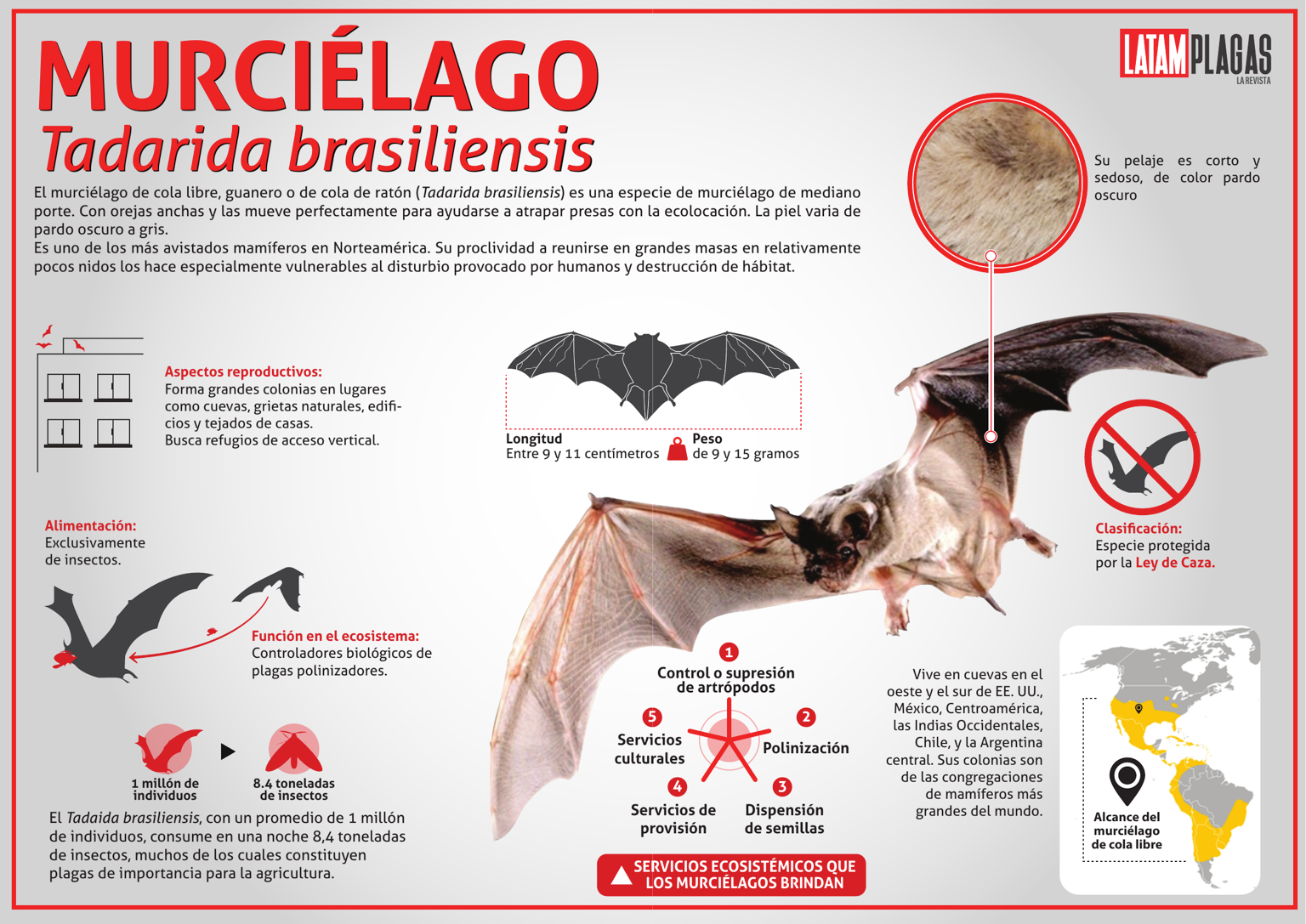
The Brazilian free-tailed bat, also known as the guano bat or mouse-tailed bat (Tadarida brasiliensis), is a medium-sized bat species. It has broad ears and short, silky fur ranging from dark brown to grey, and it relies on echolocation to catch its prey.
It is one of the most frequently sighted mammals in North America. Its tendency to gather in large colonies within a small number of roosts makes it especially vulnerable to human disturbance and habitat destruction.
Reproductive traits
It forms large colonies in caves, natural crevices, buildings and house roofs. It seeks out roosts with vertical access.
Feeding
It feeds exclusively on insects. A colony of roughly one million individuals can consume 8.4 tonnes of insects in a single night, many of them pests of agricultural importance.
Ecosystem services
Bats provide arthropod control or suppression, pollination, seed dispersal and cultural services. Tadarida brasiliensis is protected under Argentina's hunting legislation (Ley de Caza).
Distribution
It lives in caves across the western and southern United States, Mexico, Central America, the West Indies, Chile and central Argentina. Its colonies rank among the largest mammal congregations in the world.