
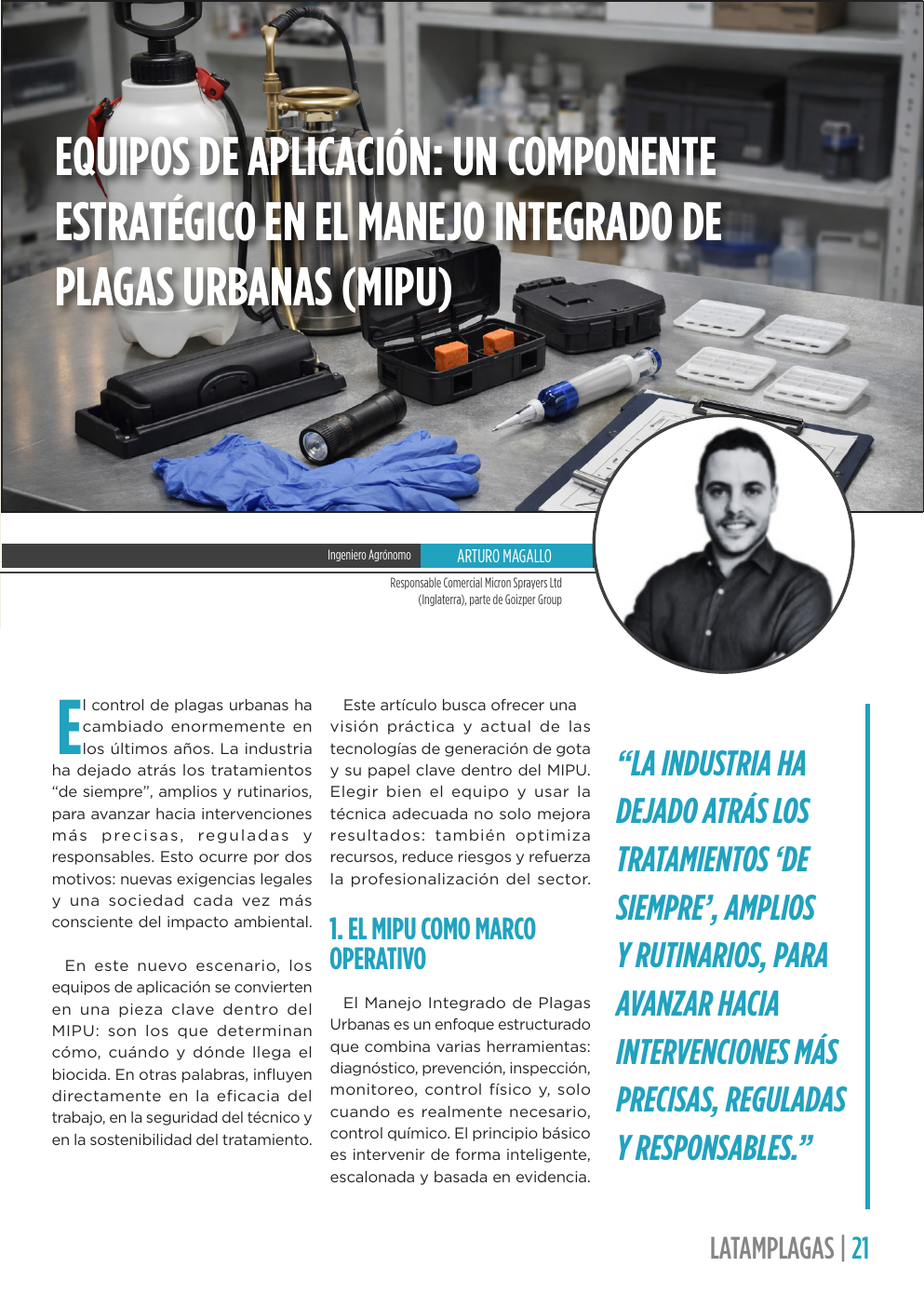
Application equipment: a strategic component in Integrated Urban Pest Management
Urban pest control has changed enormously in recent years. The industry has left behind the “usual”, broad and routine treatments, to move towards more precise, regulated and responsible interventions.
Technical summary
- Focus
- The industry has left behind the “usual”, broad and routine treatments, to move towards more precise, regulated and responsible interventions.
- Approach
- The article structures the analysis around The IUPM as an operational framework, The relevance of drop size in the effectiveness of the treatment and The manufacturer's perspective: quality, support and sustainability.
- Use
- Useful for professionals who need context, diagnosis and operational decisions in urban pests.
Index
- The IUPM as an operational framework
- The relevance of drop size in the effectiveness of the treatment
- The manufacturer's perspective: quality, support and sustainability
- Application techniques
- Manual spraying: focused control and residuality
- Portable cold misting: indoor effectiveness
- Thermofogging: maximum penetration
- Vehicle cold fogging: efficiency on large surfaces
- Aerial application in urban and peri-urban environments
- Conclusion
Urban pest control has changed enormously in recent years. The industry has left behind the “usual”, broad and routine treatments, to move towards more precise, regulated and responsible interventions. This occurs for two reasons: new legal requirements and a society increasingly aware of environmental impact.
This article seeks to offer a practical and current vision of droplet generation technologies and their key role within the IUPM. Choosing the equipment well and using the appropriate technique not only improves results: it also optimizes resources, reduces risks and reinforces the professionalization of the sector.
“The industry has left behind the usual, broad and routine treatments, to move towards more precise, regulated and responsible interventions.”
The IUPM as an operational framework
In this new scenario, application teams become a key piece within Integrated Urban Pest Management. They are the ones that determine how, when and where the biocide arrives. In other words, they directly influence the effectiveness of the work, the safety of the technician and the sustainability of the treatment.
Integrated Urban Pest Management is a structured approach that combines several tools: diagnosis, prevention, inspection, monitoring, physical control and, only when really necessary, chemical control. The basic principle is to intervene in an intelligent, phased and evidence-based way.
Urban pests act in complex environments such as sewers, hospitals, industries, homes and densely populated infrastructures. This requires specialized technicians capable of accurately identifying the pest cycle, establishing intervention thresholds and selecting the active ingredient and the appropriate application technique. This is where application equipment comes into play, as a vehicle that guarantees that the biocide reaches where it should, in the correct dose and with the appropriate droplet size.
The relevance of drop size in the effectiveness of the treatment
It is often thought that applying the same product and the same dose guarantees the same result. But it is not like that. Technique, equipment and calibration can change the behavior of the active ingredient: how it is deposited, how much it penetrates, how long it lasts and how far it goes.
Droplet size is one of the most critical factors. Large drops cause excessive wetting, runoff and poor coverage. In turn, droplets that are too small can evaporate before reaching the target, drift easily, or not have enough mass to impact. Controlling the droplet size allows you to optimize the product, improve effectiveness and reduce risks for both people and the environment.
“Controlling the droplet size allows you to optimize the product, improve efficacy and reduce risks.”
The manufacturer's perspective: quality, support and sustainability
Poorly calibrated equipment can lead to scenarios of underdosing, overdosing, drift, and avoidable operating costs. For all these reasons, the choice of equipment must be a strategic decision.
For manufacturers, the integrated approach does not end with selling a piece of equipment. It includes its entire life cycle: available spare parts, preventive maintenance and continuous technical support. Modern equipment must be robust, reliable and built with materials compatible with increasingly demanding formulations.
Being able to repair our equipment is essential. Not only does it allow us to work without interruptions for years, but it is also the best way to generate less waste.
Application techniques
Manual spraying: focused control and residuality
Manual spraying remains one of the most effective techniques, especially when precision is required. A well-calibrated sprayer allows for specific applications in critical areas and treatments in cracks and crevices where many pests hide, allowing for less exposure for the operator and control of the applied dose.
It is essential that the equipment has a pressure regulator, adequate nozzles and incorporates resistant materials. Correct calibration guarantees repeatable applications, essential in residual treatments.
Portable cold misting: indoor effectiveness
ULV fogging produces very fine droplets, generally smaller than 30 microns, that remain suspended in the air. This makes it ideal for interiors where a homogeneous dispersion of the active ingredient is sought. Its key principles are droplet size uniformity to maximize suspension time and minimize deposition on surfaces, avoiding wetting.
Today, portable wireless equipment with lithium batteries stands out, very practical in spaces that require maneuverability or where there is no power outlet.
Thermofogging: maximum penetration
Thermofogging generates aerosols using heat, achieving extremely fine droplets that penetrate complex structures such as sewage networks, compact vegetation or interior spaces, according to current legislation in each country.
Requires strict temperature control to prevent degradation of sensitive ingredients. Likewise, it is essential to use and know the appropriate vehicle, whether glycol, mineral oil, diesel, etc. Modern equipment includes automatic cutting systems to avoid risks such as the famous “flame.”
Vehicle cold fogging: efficiency on large surfaces
Vehicle-mounted ULV fogging is imperative in large-scale mosquito and vector control programs. It allows you to work with droplets smaller than 30 microns and cover large areas in a short time. Its advantages are application at constant speed, high productivity in urban and industrial areas and rapid coverage of large areas.
In recent times, in addition to ULV application of adulticides, vehicular equipment is being used for larvicidal applications in large areas within a preventive approach. There are heavy long-range equipment and compact equipment with CDA technology on the market to be placed in a conventional truck.
“Improperly calibrated equipment can cause scenarios of underdosing, overdosing, drift and avoidable operating costs.”
The current trend is compact equipment, lower horsepower motors and sensors that automatically stop the application if conditions are not correct. The future lies in its integration with GPS and Geographic Information Systems for advanced traceability and data management. Micronair-type rotating nozzles are the most used due to their ability to generate uniform drops and reduce drift.
Aerial application in urban and peri-urban environments
Aerial application is a highly regulated technique and reserved for exceptional situations: epidemic outbreaks or emergencies that require massive treatments in a short time. It is subject to strict regulation by the authorities and requires great technical knowledge on the part of the applicator pilot in controlling drift and evaporation.
Conclusion
The success of an IUPM program depends, above all, on combining the right equipment with the right technique. Factors such as droplet size, calibration and good maintenance are what really define the effectiveness of the treatment, the safety of the applicator and the environmental impact.
In the face of increasingly strict regulations, application technology becomes a fundamental pillar to professionalize the sector. Therefore, choosing robust equipment with good technical support is not a luxury; It is an essential requirement to intervene with precision, efficiency and responsibility.