
Mosquitoes in the spotlight: innovative techniques for mosquito control in Latin America
In Latin America, mosquito-borne diseases such as malaria, dengue and Zika represent a significant threat to public health.




Listen to this article with your device’s voice.
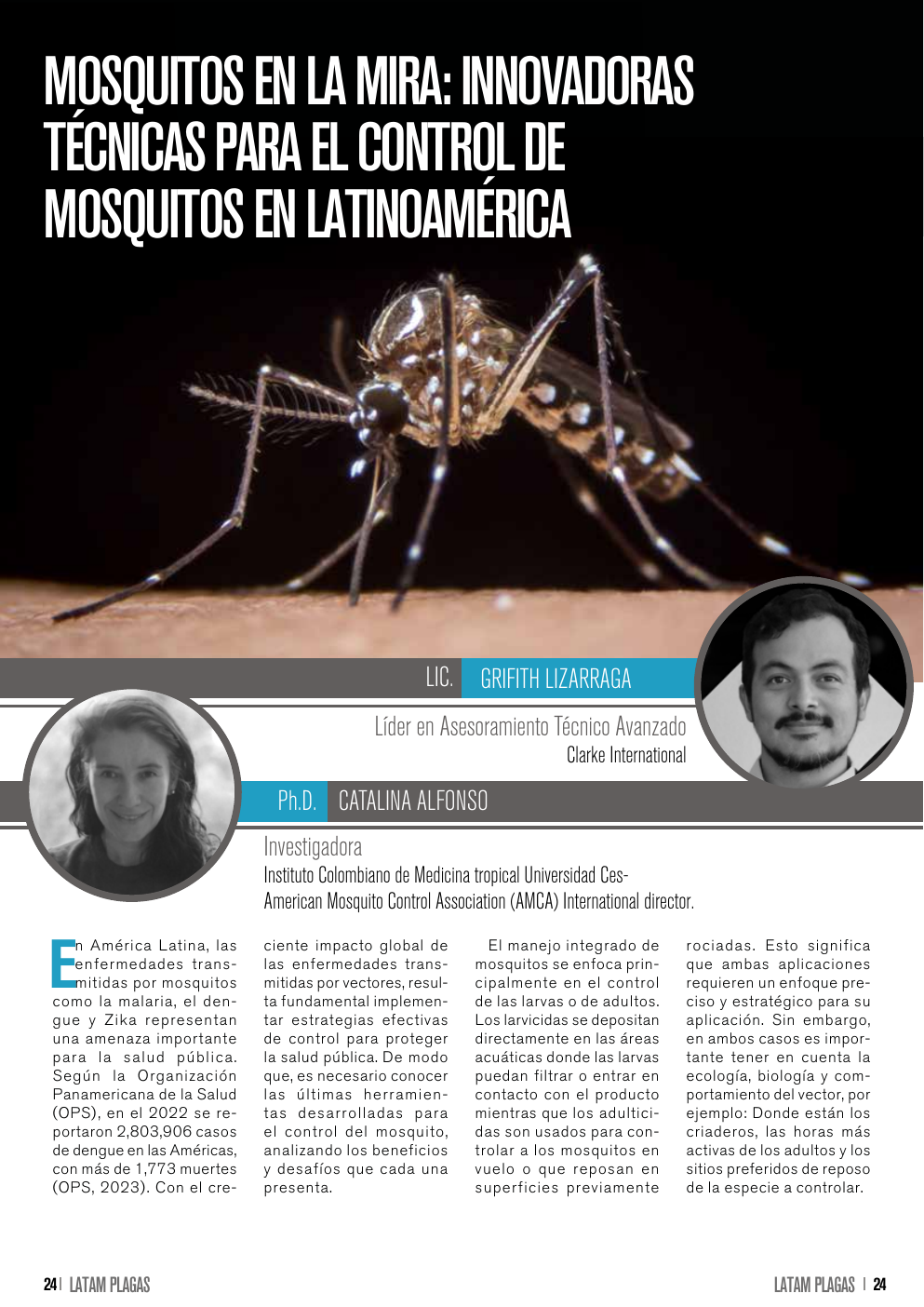
In Latin America, mosquito-borne diseases such as malaria, dengue and Zika represent a major threat to public health. According to the Pan American Health Organization (PAHO), 2,803,906 dengue cases were reported in the Americas in 2022, with more than 1,773 deaths (PAHO, 2023). With the growing global impact of vector-borne diseases, effective control strategies are essential to protect public health. It is therefore necessary to understand the latest tools developed for mosquito control, examining the benefits and challenges of each. Integrated mosquito management focuses primarily on controlling larvae or adults. Larvicides are deposited directly in aquatic areas where larvae can filter or come into contact with the product, while adulticides are used to control mosquitoes in flight or resting on previously sprayed surfaces. Both applications therefore require a precise, strategic approach. In both cases, however, the vector's ecology, biology and behaviour must be considered: for example, the location of breeding sites, the adults' most active hours and the preferred resting sites of the species being controlled. Mosquito larval control has evolved continuously in recent decades, from the introduction of temephos in the 1950s to applications of liquid and granular larvicides, such as spinosad or BTI, using aerial and ground dispersal techniques. For control to succeed, it is crucial to use the appropriate larvicide for the mosquito species concerned. Areas where mosquito larvae develop must also be identified, and the larvicide applied accurately and promptly. One larvicide dispersal technique currently used for urban mosquito control is Wide Area Larviciding (WAL). This involves applying liquid larvicides, mainly spinosad and BTI, with a vertically directed atomizer reaching up to 20 metres. The atomizer produces droplets of different sizes (<50 to more than 600 microns) which, on reaching their terminal height, disperse over areas to reduce mosquito larval populations. Larger droplets control larvae near the street, such as in drains and pools of water, while smaller droplets can penetrate yards and areas behind houses to control cryptic or hard-to-reach breeding sites. Several high-capacity machines can be used for WAL applications, but the best known so far is the Buffalo Turbine, which uses a turbine to create an air stream that disperses larvicide droplets over a wide radius. This air stream reaches speeds of up to 160 km/h and uses a Micronair nozzle, commonly employed for aerial applications, model AU5000, rotating at 6,000 to 9,000 RPM. The nozzle sleeve can be redirected by remote control to apply the product in areas where environmental conditions do not favour cloud dispersal. Adulticides can be applied manually, from the ground or from the air. Aerial applications are a rapid, extensive and highly effective method of controlling adult mosquitoes. Applications must take place at specific times, during dusk or at night, when mosquitoes are most active. Indoor Residual Spraying (IRS) is a widely used manual application method that involves applying insecticides to walls and, in some cases, interior ceilings. This technique aims to bring mosquitoes into contact with sprayed surfaces. The insecticides used in IRS have a residual effect that provides long-term protection against populations susceptible to the formulation's active ingredient. However, the development of insecticide resistance has become a significant challenge to IRS effectiveness. IRS is also labour-intensive and may not be suitable for all types of housing or areas with high mosquito densities. A recent modification of IRS involves applications to specific areas, known as Targeted Indoor Residual Spray (TIRS). Unlike traditional IRS, TIRS involves applying insecticides to specific interior surfaces that are more likely to come into contact with a larger number of mosquitoes. This technique primarily targets urban areas and depends on community participation for success. TIRS is more sustainable in its use of resources and reduces insecticide exposure for people living in houses compared with traditional IRS. The Autonomous University of Yucatán, in collaboration with Emory University (Prokopec Laboratory) and the Collaborative Unit for Entomological Bioassays (UCBE), currently leads worldwide research and application efforts on TIRS. One of the most common and effective spatial mosquito control techniques is thermal fogging, which can be applied manually, from the ground or from the air. Thermal fogging involves applying a product as a thermal mist. Insecticides are vaporized by heat, forming a fine fog that disperses in the air and affects mosquitoes that come into contact with it. This technique is commonly used in urban areas to control adult mosquito populations inside and around homes. Like thermal fogging, Ultra Low Volume (ULV) application involves spatial insecticide dispersal using air pressure generated by the equipment. This technique uses a special nozzle that produces very small droplets, generally between 10 and 30 microns in median diameter, creating a cloud that disperses in the air and expands in the desired direction. This technique is highly effective for controlling adult mosquitoes over large areas when applied aerially, or precisely when applied from the ground; its success depends heavily on environmental conditions at the time of application. Aerial adulticide applications are highly effective for controlling adult mosquitoes, and drones have proved valuable for vector control, especially in hard-to-reach areas. Drones have been equipped with sprayers to apply insecticides and larvicides, although their payload is limited. Drones can also be used for surveillance and monitoring of mosquito populations in remote areas, such as mangroves, wetlands or coasts, helping vector-control teams direct their efforts more effectively. Advances in drone technology offer an increasingly important tool, especially with larger payloads and longer-range flights. Aerial or drone applications can be costly and require significant resources in vector-control programmes. In addition to techniques and equipment using insecticides as the main control method, other methods have been developed to reduce vector-borne disease transmission. Examples include releasing mosquitoes infected with Wolbachia to suppress or replace populations, or releasing genetically modified mosquitoes or sterile males to reduce the vector population. These techniques depend on vector biology for successful operation. Despite the many mosquito control options and methods, resources are often limited, making it important to find a balance and sustainable alternatives. In such situations, vector-control approaches focused on prevention, such as eliminating mosquito breeding sites and educating communities on preventing mosquito reproduction, may be more effective. Integrated management is a joint effort requiring cooperation among communities, private industry, government and public-health experts. We need to make the most of every voice and resource to combat mosquitoes in our communities. As new control tools are developed, they must be accessible and effective for everyone, especially groups most vulnerable to vector-borne diseases. Finally, mosquitoes do not recognize borders. We must work together, learn from others' experiences and actively support research, innovation and the development of control techniques to ensure a healthier, safer future for our populations. WHO-prequalified product. An effective alternative for controlling adult Aedes aegypti populations resistant to pyrethroids and organophosphates.