
Essential oils and their potential in integrated urban pest management
Essential oils are chemically complex, volatile products, very widely distributed throughout the plant kingdom. They are generally liquid mixtures of several components.
Technical summary
- Focus
- Essential oils are chemically complex, volatile products, very widely distributed throughout the plant kingdom. They are generally liquid mixtures of several components.
- Approach
- The article structures the analysis around General uses of essential oils.
- Use
- Useful for professionals who need context, diagnosis and operational decisions in urban pests.
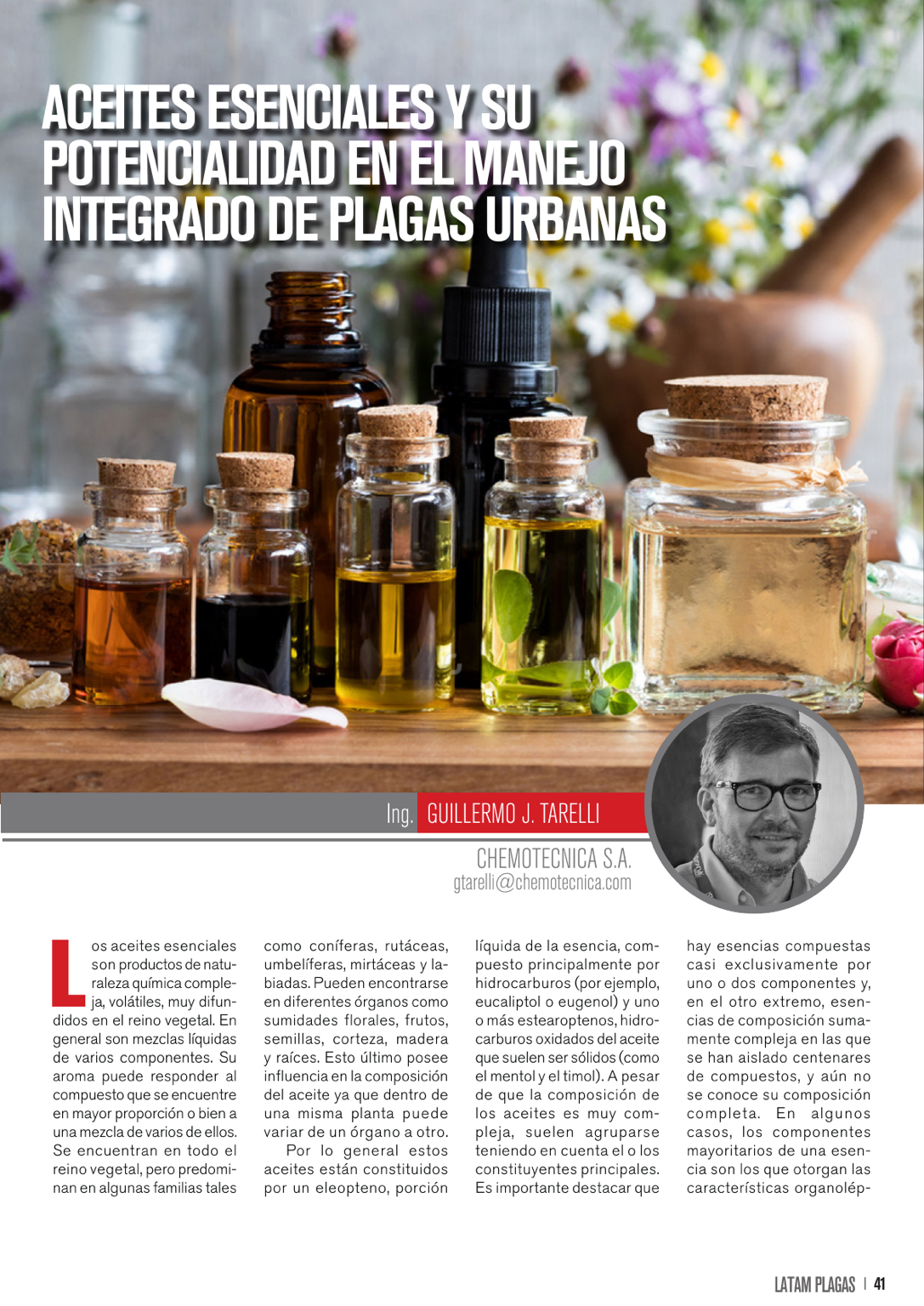
Essential oils are chemically complex, volatile products, very widely distributed throughout the plant kingdom. They are generally liquid mixtures of several components. Their aroma may come from whichever compound is present in the greatest proportion, or from a mixture of several. They occur throughout the plant kingdom, but predominate in certain families such
as the conifers, Rutaceae, Umbelliferae, Myrtaceae and Labiatae. They can be found in different organs: flowering tops, fruit, seeds, bark, wood and roots. This last point has a bearing on the composition of the oil, since within a single plant it can vary from one organ to another. These oils generally consist of an eleoptene — the liquid portion
of the essence, made up mainly of hydrocarbons (eucalyptol or eugenol, for example) — and one or more stearoptenes, oxidised hydrocarbons of the oil that are usually solid (such as menthol and thymol). Although the composition of these oils is very complex, they tend to be grouped according to their principal constituent or constituents. It is worth noting that
there are essences made up almost exclusively of one or two components and, at the other extreme, essences of extremely complex composition in which hundreds of compounds have been isolated and whose full composition is still unknown. In some cases the majority components of an essence are the ones that give it its organoleptic or pharmacological characteristics. In others, it is substances present in trace amounts that define the oil's flavour, smell or properties. As for their physical properties, these oils are generally liquid at ordinary temperature and aromatic in smell. Their density is usually lower than that of water, with some exceptions such as cinnamon. They have a high refractive index, are volatile and can be carried over in steam. They are very sparingly soluble in water, but enough to impart their smell to it. They are soluble in alcohol, ether, most non-polar solvents and fixed oils.
General uses of essential oils
Two large markets can be described among the general uses of essential oils. The first arises from their organoleptic characteristics and is exploited primarily by the flavour and fragrance industry. A third, more specific use would relate to incorporating oils, or some of their isolated components, into the formulation of products intended for pest management. For some years now the insecticidal effect of different molecules of natural origin has been under study worldwide. Essential oils fall within the broad spectrum of natural products. Several of them have been shown to have a lethal effect on different pest organisms and now constitute an extremely important tool for tackling the mechanisms of resistance to conventional insecticides developed by some of those organisms. Another highly relevant characteristic is the low environmental impact of these products. The potential of essential oils as protectants for stored grain has been well documented (Shaaya et al., 1991; Regnault-Roger et al., 1993). Toxicity against Blattella
germanica and Periplaneta americana has been demonstrated in the laboratory (Cotas et al., 1991; Ago et al., 1998). They are also effective against ectoparasites such as the cat flea and mites. They likewise show great potential for controlling body and head lice in humans (Mumcuoglu et al., 1996). Some compounds present in essential oils have a strong knockdown effect on flying insects such as flies, mosquitoes and wasps (Cornelius et al., 1997). Oils of Eucalyptus globulus, Lavandula officinalis, Rosmarinus officinalis and Thymus vulgaris have shown repellency against Culex pipiens pallens (Choi et al., 2002). Thymol is being used extensively in the control of Varroa jacobsoni (Imdorf and Bogdanov, 1999). There is a great variety of essential oils, or components of them, that act as
repellents, attractants or acaricides. In Bolivia, essential oils of Minthostachys andina and Hedeoma mandonianum — medicinal plants habitually used as insecticides — are employed to control vectors of Chagas disease (Fournet et al., 1996). Compounds such as petunioid C and an ergostane-type steroid have been isolated from the foliage of Petunia parodii. These compounds cause incoordination and salivation in fourth-instar nymphs of the locust Schistocerca gregaria (Isman et al., 1997). The effect of compounds such as alpha-pinene has been evaluated against stored grain pests (Huang et al., 1998). The oil extracted from the roots of Vetiveria zizanioides acts directly on the tunnelling behaviour of Coptotermes formosanus (Maistrello et al., 2001). In my own experience, carrying out trials for my master's thesis a good many years ago, we were able to evaluate the biological effects (knockdown and mortality) of some essential oils and their monoterpenes on Musca domestica. Graph 1 shows the results of the knockdown effect (knockdown time = KT) produced in adult male Musca domestica by commercial essential oils and DDVP, applied as acetone solutions on filter paper. It is worth recalling that dichlorvos, or DDVP, has historically been one of the organophosphate molecules with the fastest knockdown. The KT50 of DDVP (2.39 min) was significantly lower than that of all the oils studied (P < 0.05). Among the oils, the most effective was eucalyptus, with a KT50 of 4.3 min, followed in decreasing order of toxicity by orange, mint, lavender and geranium. No significant differences were observed between the KT50 values of orange, mint and lavender oils (P > 0.05), whereas the KT50 of geranium oil (17.5 min) was significantly higher than all the others (P < 0.05). Application in a silicone base produced a delay of between two and four
times in the knockdown speed of all the oils (graph 2), except in the case of orange oil, which was delayed more than sixfold. The order of toxicity observed when the oils were applied as acetone solutions was maintained with the silicone base. In every case, the KT50 values of the oils in a silicone base were significantly higher than the corresponding values in acetone solution (P < 0.05). Graph 3 shows the results of the knockdown effect produced by the pure components applied as acetone solutions on filter paper. The KT50 of eucalyptol (2.29 min) was significantly lower than that of the other components studied (P < 0.05), but showed no significant difference from the KT50 of DDVP (2.39 min).
Eucalyptol was followed, in decreasing order of toxicity, by limonene, linalool, menthone and menthyl acetate (the KT50 of the last being 22.56 min). Applying the components in a silicone base delayed their knockdown speeds (graph 4). The results of the mortality trial produced by the oils applied as acetone solutions by topical abdominal application are shown in graph 5. Geranium oil showed a significantly more effective lethal effect than the other oils (P < 0.05). Oils of Eucalyptus globulus, Lavandula officinalis, Rosmarinus officinalis and Thymus vulgaris have been used in repellency trials against Culex pipiens pallens. Those oils were applied to shaved mice, and the number of mosquito bites over one hour was recorded. After that period the number of bites was 5.2, 6.0, 4.0 and 1.6 respectively, against 17.2 bites in the control. This shows that Thymus vulgaris has 91% efficacy as a repellent. On that basis, gas chromatography coupled to mass spectrometry was used to identify the main components of that oil. Five monoterpenes were found, including thymol, p-cymene, carvacrol, linalool and alpha-terpinene. The two
The results of the lethal effect produced by the pure components applied as acetone solutions by topical abdominal application are shown in graph 6. Linalool showed a significantly more effective lethal effect than the others
principal ones, thymol and alpha-terpinene, were evaluated in the same way and showed efficacy of 97% and 96% against the 89% efficacy of DEET (Choi et al., 2002). Thymol is being used extensively in the control of Varroa jacobsoni. There is a great variety of essential oils, or components of them, that act as repellents, attractants or acaricides. Thymol has an acaricidal effect on this mite, with efficacy ranging from 90 to 100%, and leaves no residues in honey. The compound is solid and is applied directly to the frames of the hive. In Bolivia, essential oils of Minthostachys andina and Hedeoma mandonianum — medicinal plants habitually used as insecticides — are employed to control vectors of Chagas disease. The first of these species contains 25.5% pulegone and 33% menthone and isomenthone respectively. The second reaches 44.6% pulegone and equal values of menthone and isomenthone. Minthostachys andina oil produced mortality values of 30 to 50% against Rhodnius neglectus and Triatoma infestans exposed on filter paper, whereas Hedeoma mandonianum showed no insecticidal effect. Applied topically, both oils gave mortality values of 33 to 50% (Fournet et al., 1996). Compounds such as petunioid C and an ergostane-type steroid have been isolated from the foliage of Petunia parodii. These compounds cause incoordination and salivation in fourth-instar nymphs of the locust Schistocerca gregaria when injected into the haemolymph at doses of 0.5 micrograms per insect. The median lethal dose for this compound is very similar to that of the convulsant picrotoxin, which acts on GABA-gated chloride ionophores; hence they are considered antagonists of those receptors (Murria et al., 1997). The effect of compounds such as alpha-pinene has been evaluated against stored grain pests. This compound has been shown to have an antifeedant and
growth-regulating effect on Tribolium castaneum (Huang et al., 1998). The oil extracted from the roots of Vetiveria zizanioides acts directly on the tunnelling behaviour of Coptotermes formosanus (Isoptera: Rhinotermitidae). As a result, after 21 days, wood consumption and termite survival were significantly reduced compared with untreated sand (Maistrello et al., 2001). Almost 20 years have passed since the trials I carried out looking for environmentally friendly pest control alternatives, and their potential application is undoubtedly still of great interest. The evidence indicates that it is feasible to use natural compounds of low environmental impact, associated of course with the preventive aspects proper to any integrated management programme. The great challenge for our supplier industries remains the development of formulations that are economically viable and acceptable to service companies. On that last point, training and pre- and post-sales support are key. The world and society as a whole are demanding pest and vector control strategies with less impact on the environment. We must press on with developing formulations and methods of use that allow laboratory results to be replicated in specialist services. Several “organic” product lines for controlling insects and mites exist around the world, but they still account for a small share of use by professional pest management companies. One of the objectives we should set ourselves as an industry for the years ahead is undoubtedly to bring compounds of this kind into our toolkit.