The wolf is coming! How to face auditors
There is one figure who represents a nuisance for the pest control professional: the auditor.
Technical summary
- Focus
- There is one figure who represents a nuisance for the pest control professional: the auditor.
- Approach
- The article structures the analysis around Why does an auditor exist? What is their function? and 1. the requirements of one or more.
- Use
- Useful for professionals who need context, diagnosis and operational decisions in integrated management.
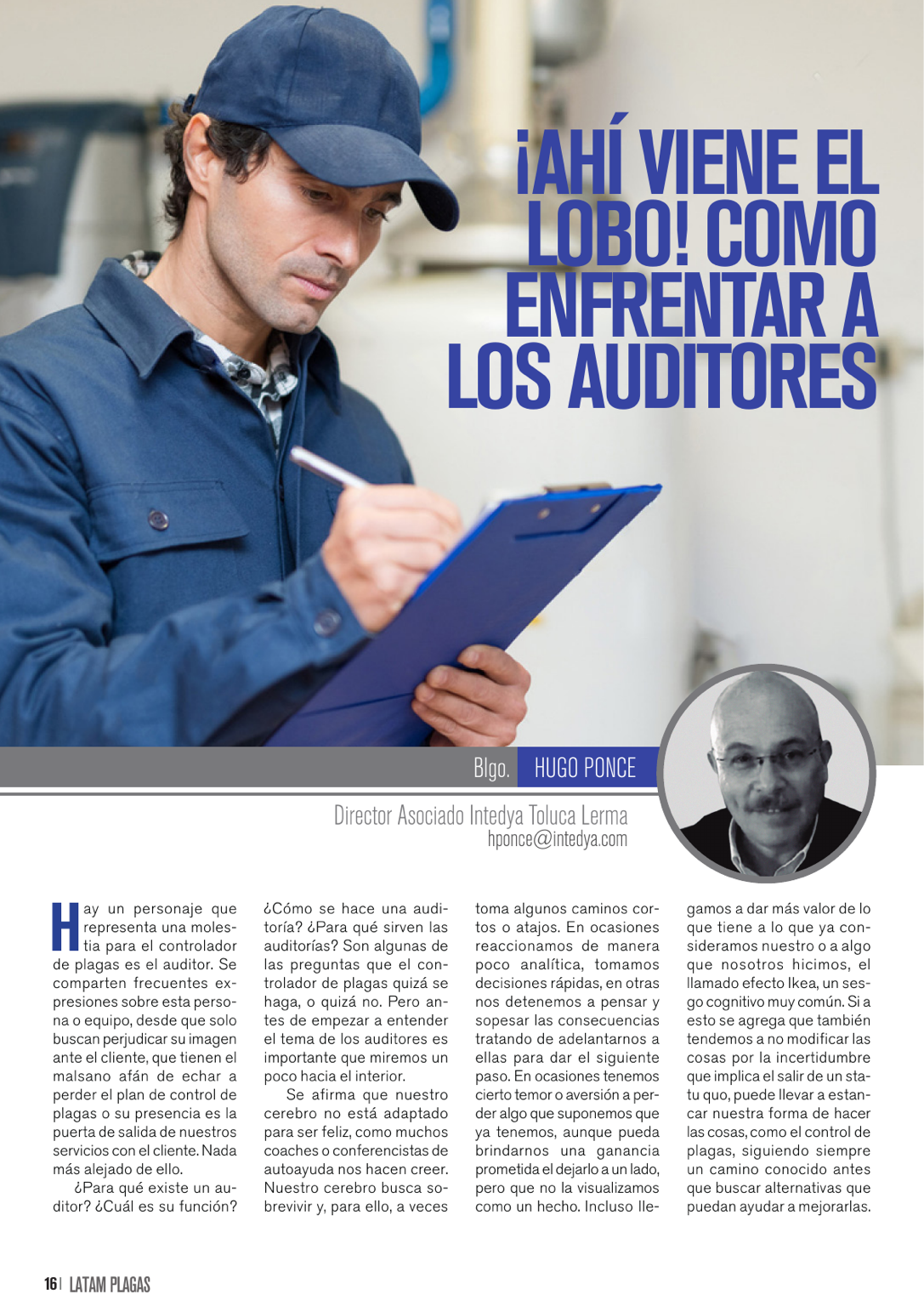
There is one figure who represents a nuisance for the pest control professional: the auditor. People often say things about this person or team — that they are only out to damage your standing with the client, that they have an unhealthy urge to wreck the pest control plan, or that their presence is the exit door for your services with that client. Nothing could be further from the truth.
Why does an auditor exist? What is their function?
How is an audit carried out? What are audits for? These are some of the questions a pest control professional may — or may not — ask. Before we start making sense of auditors, though, it is worth looking inward for a moment. It is said that our brain is not built to make us happy, whatever many coaches and self-help speakers would have us believe. Our brain is trying to survive, and to do so it sometimes
takes shortcuts. Sometimes we react with little analysis and make quick decisions; at other times we stop to think and weigh consequences, trying to get ahead of them before taking the next step. Sometimes we feel a degree of fear or aversion about losing something we assume we already have, even when setting it aside might bring a promised gain — because we cannot picture that gain as a fact. We even attach more value than it deserves to whatever we already consider ours, or to something we made ourselves: the so-called IKEA effect, a very common cognitive bias. Add to this our tendency not to change things because of the uncertainty involved in leaving the status quo, and the result can be that our way of doing things — pest control, for instance — stagnates, always following a familiar path rather than looking for alternatives that might improve it. To avoid falling into these and other biases, guidelines are established that point to a better route for managing reliability, risk and resilience. That is: whether what we do performs as expected, the uncertainty that might pull us away from our objective, and our capacity to return to the original plan. These rules can be set by ourselves, by a third party acting as an independent expert, or by the authorities — in other words, policies, standards, norms, regulations and laws. Establishing rules also allows us to coexist better with our surroundings, with the benefits that brings us. But human beings are creatures of shortcuts, as we said, and we frequently find ways not to follow rules — from our own point of view, a saving in the resources we assign
to our decisions. Taking a decision always has consequences. Stanford University defines a decision as an irrevocable and irreversible action, chosen among options or alternatives, that allocates resources; if we do not consider those resources we are merely drawing up a plan of action or, worse still, an inaction, usually born of fear of negative consequences. As we know, ignorance is the mother of fear or, put another way, our fears are almost always
born of what we do not know, and avoiding them makes us believe we are avoiding risk. One way to confront risk is with the help of someone who does not share our bias, positive or negative, towards what has been established as the route to reaching objectives reliably, and who can point out the deviations that stop us keeping resilience manageable. That is an auditor's function. Auditors were originally known in old England as “listeners”, and their job was to guide and judge the truth of what people — commonly
large landowners, who as a rule could not read — told them, by listening. According to ISO 19011, an auditor is “one or more persons conducting an audit, supported if needed by technical experts”. From here we can address one of the pest control professional's main complaints about auditors: the claim that it makes no sense for someone who “knows nothing about pest control” to “grade their work”. That is what the technical expert is for — “a person who provides specific knowledge or expertise to the audit team” — and who, ideally and in a collaborative spirit, may well be the pest control professional. The same ISO 10011 standard states that an audit is a “systematic, independent and documented process for obtaining objective evidence and evaluating it objectively to determine the extent to which the criteria are fulfilled”. Here we find another key word: criteria, which come from three possible sources, as mentioned above:
1. the requirements of one or more
standards the company has chosen to adopt, 2. the policies and requirements of the contracting company, or 3. legal and regulatory requirements that apply as a matter of obligation. To carry out the audit, the auditor must be well versed in those criteria, which are reviewed at the request of the company itself (first party), by a client or another interested party of the client (second party), or for the purposes of certification, accreditation or legal compliance (third party). The auditor in turn must uphold seven principles. Integrity, acting ethically and responsibly. Fairness in their work, so that it is truthful and accurate, without value judgements. Professionalism, holding and properly applying their knowledge. Confidentiality, handling and protecting information correctly. Independence from the activity or function being audited, wherever possible. An evidence-based approach rather than value judgements. And a risk-based approach that allows threats and opportunities to be identified. In light of the above, when an auditor asks for information about the pest control plan, what they are looking for is evidence that the plan is meeting the objectives required by a defined standard — and that is not, in fact never, a given number of dead pests. What the auditor is really looking for is compliance or non-compliance (not failures) with the necessary criteria, which have to do with the absence of pests on the premises. The pest control professional, for their part, ought to know those criteria and apply them in their plan before any audit, even where the standards do not apply to them directly. Let us pause here and think back to our school years — particularly to those occasions when, as we saw it, we studied diligently for a particularly important exam. After hours of anxiety, exam day arrived and we answered with the self-confidence we had built as a defence against fear. Then the day came when the teacher handed back our results and, with a mixture of sadness, disappointment and anger, we saw that we had not got the mark we expected. Even if it was not altogether bad — what makes us react like that? It is a combination of the biases mentioned earlier: faced with what we ourselves had graded a great effort, we were not judged to match. We resist being “graded” differently from how we see ourselves. Sometimes this means we turn up to subsequent exams with a certain prejudice that whatever we do, we will not be assessed well, as we see it. But we forget that our teacher did not assess the hours of study or the sleepless nights, but a simple outcome: the answers on the exam, the evidence. Quite often the pest control professional expresses a dread of “non-conformities”. They want to avoid them at all costs, even trying to influence the auditor (a terrible mistake). Non-conformities are simply a failure to meet a requirement. The auditor will record them in their report together with a reference to the requirement concerned. What an opportunity! It is as though, when handing back that exam, the teacher had marked beside each mistake exactly where to find the right answer so as not to get it wrong again.