
When rivers bite: the problem of black flies in Latin America
In many regions of the Americas there is a small insect capable of turning farming, livestock or recreational activities into an outright nightmare.




Listen to this article with your device’s voice.
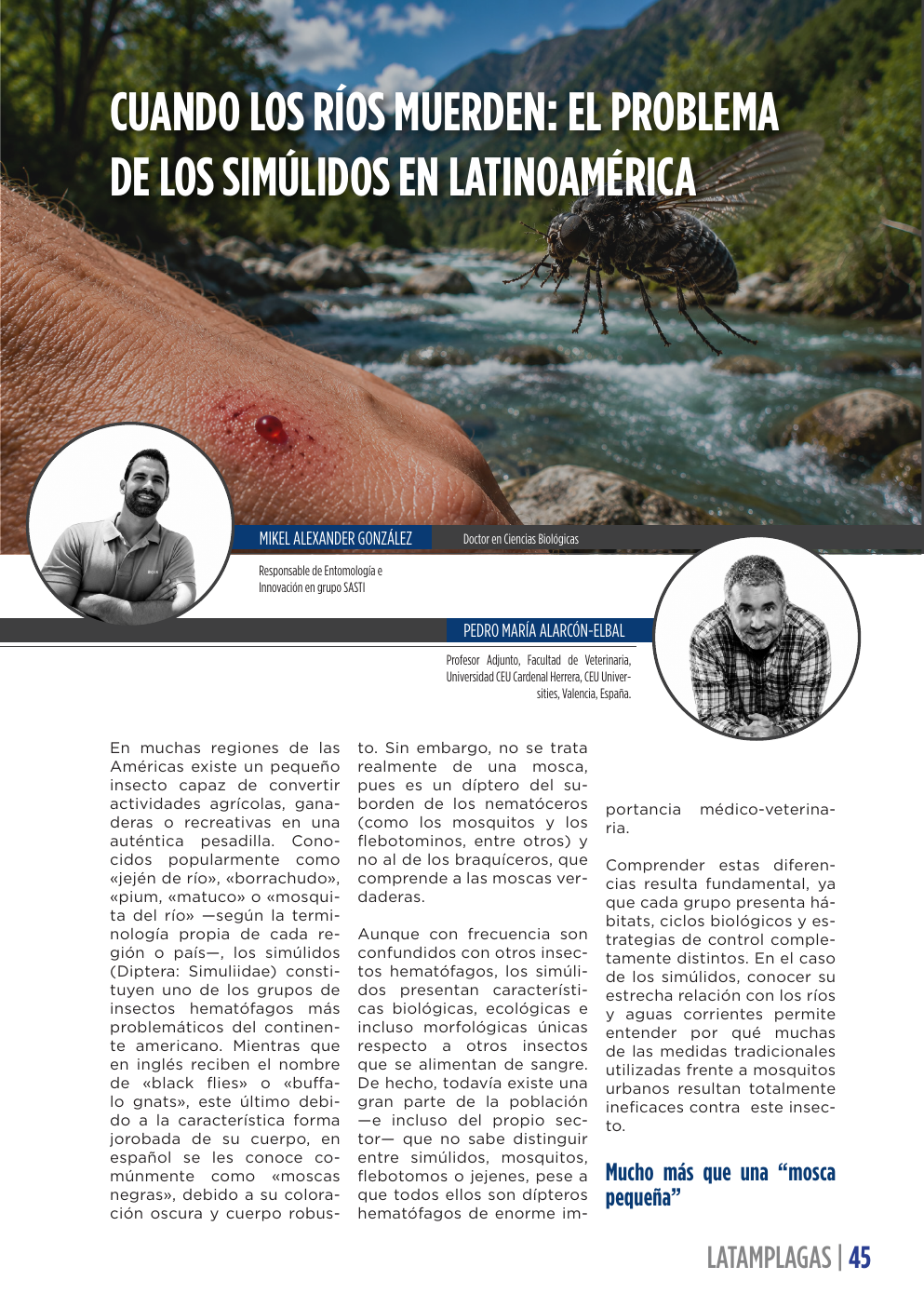
In many regions of the Americas there is a small insect capable of turning farming, livestock or recreational activities into an outright nightmare. Popularly known as jején de río, borrachudo, pium, matuco or mosquita del río — depending on the terminology of each region or country — black flies (Diptera: Simuliidae) are one of the most troublesome groups of blood-feeding insects on the American continent. In English they are called black flies or buffalo gnats, the latter because of the characteristic humped shape of their body; in Spanish they are commonly known as moscas negras on account of their dark colouring and robust build. They are not, however, true flies: they are dipterans of the suborder Nematocera (like mosquitoes and sand flies, among others) rather than the Brachycera, which comprises the true flies. Although they are frequently confused with other blood-feeding insects, black flies have unique biological, ecological and even morphological characteristics compared with other insects that feed on blood. Indeed, a large part of the public — and even of the sector itself — still cannot tell black flies, mosquitoes, sand flies and biting midges apart, even though all of them are blood-feeding dipterans of enormous medical and veterinary importance. Understanding these differences is fundamental, since each group has completely different habitats, life cycles and control strategies. In the case of black flies, knowing their close relationship with rivers and running water makes it possible to understand why many of the traditional measures used against urban mosquitoes are wholly ineffective against this insect.
Far more than a “small fly”
Adult black flies are small, robust dipterans of between 2 and 5 millimetres, generally dark in colour, with a compact body and a characteristic “humped” appearance owing to the strong development of the thorax. They have short antennae, broad transparent wings without scales, and sturdy legs; the females have mouthparts adapted for blood-feeding, since they need to take blood in order to complete the maturation of their eggs. One of the main differences from other blood-feeding groups such as mosquitoes, sand flies and biting midges lies precisely in the way they produce the lesion on the skin. Whereas mosquitoes pierce the skin with a fine proboscis — a mechanism known in biological jargon as solenophagy — black flies literally “bite”, using cutting mouthparts that superficially tear the tissues so they can feed on the small pool of blood that forms, a mechanism known in this case as telmophagy. For this reason, the lesions caused by black flies can easily be distinguished from those produced by other blood-feeding insects. They usually leave a small haemorrhagic lesion with a characteristic red central point and, in some cases, a tiny drop of blood can even be seen on the skin after the bite — something rare in the groups mentioned above. Moreover, although the clinical response can vary considerably between individuals, a common pattern exists: the bites tend to trigger an intense inflammatory reaction, itching that persists for several days and, in particularly sensitive people, allergic reactions of high intensity and even severity. The authors of the study relate that, during a stay in Colombia, they had the opportunity to explain these differences directly in the field. After suffering multiple black fly bites near watercourses in the coffee-growing region (Pereira), they were able to confirm how, unlike mosquito bites, the itching and inflammation persisted for several days after the attack, accompanied by small and highly characteristic haemorrhagic lesions in which the red central point was visible in every case.
A very common mistake: they do not breed in standing water
One of the most important things the public needs to know is that the immature stages of black flies do not develop in standing water, as those of mosquitoes do. While species such as Aedes aegypti or Culex quinquefasciatus use containers, puddles or accumulations of water with little or no circulation (lentic environments) to complete their life cycle, black fly larvae require exactly the opposite: clean, well-oxygenated running water (lotic environments). Their immature stages remain attached by specialised structures to rocks, aquatic vegetation, submerged logs, leaves or even hydraulic structures, always in environments such as streams, brooks, rivers, irrigation channels or canals with a fast current. The larvae have filtering structures that allow them to capture organic particles suspended in the water. Several studies have in fact highlighted their potential as bioindicators of water quality, since their presence and abundance reflect the conditions of the aquatic environment. As a result, certain environmental alterations, such as the proliferation of hydrophytes, or certain hydrological modifications, such as the construction of dams or canals, can favour significant population increases. This ecological peculiarity explains why the classic measures used against mosquitoes — removing containers of standing water or treating large natural bodies of water — are ineffective for black fly control. In the Americas there are numerous black fly species distributed from tropical regions to temperate and mountain areas. Although many barely cause a nuisance, others reach very high densities and can become a significant problem for health, tourism and livestock farming, especially in areas close to watercourses of every kind, from small streams and canals to large rivers and waterfalls.
Regions where they are a serious problem
Black flies can reach extraordinary levels in certain areas of the American continent. In Brazil, for example, borrachudos are a chronic problem in numerous states in the south and south-east, affecting residents and rural tourism alike. In Amazonian regions of Brazil, Venezuela, Colombia and Ecuador, some species produce mass attacks near river courses. In the Caribbean, black flies have historically been a little-studied group, although a recent study carried out in the Dominican Republic has revealed their abundance in lotic mountain environments in one of the country's main tourist hubs. In the United States a recent increase in black flies has also been recorded, above all in the Los Angeles area and the San Gabriel Valley, in the state of California. This increase has been associated with a large proliferation of larvae due to the management of flows in rivers and streams through releases from dams, causing public alarm because of the intensification of their bites on people and animals alike. The importance of these dipterans, however, lies in their enormous medical relevance because of their role in transmitting onchocerciasis, also known as river blindness. This disease, caused by a helminth (Onchocerca volvulus), produces lesions on human skin and eyes and can lead to blindness if not properly treated. In the Americas, onchocerciasis was present in six countries, although thanks to the Onchocerciasis Elimination Program for the Americas (OEPA) it has been eliminated in Colombia, Ecuador, Mexico and Guatemala. The only active focus today is in fact in Yanomami territory, on the border between Brazil and Venezuela, where difficult geographical access has slowed the process of eradicating this parasitic disease, considered by the WHO to be a Neglected Tropical Disease (NTD). Despite this progress in eliminating the disease, however, the fact is that black flies remain a significant public health and animal welfare problem in numerous regions of the continent. The authors point out that they have had the chance to see this on numerous trips through the Americas, especially in places such as Jarabacoa in the Dominican Republic, Ilhabela in Brazil and various parts of the Colombian coffee-growing region, where it is very common to suffer black fly attacks on approaching mountain recreational areas with watercourses. In every case, the constant presence of fast, well-oxygenated watercourses was clearly associated with the abundance of these “black flies”.
Impact on livestock farming
People are not the only ones to suffer black fly attacks. Livestock can also be seriously affected when population densities are high, especially in areas close to rivers and watercourses. The bites cause stress, behavioural changes, weight loss and a significant reduction in productivity and milk yield. In extreme situations, when thousands of insects attack animals simultaneously, a phenomenon known as simuliotoxicosis can occur, associated with the toxic action and intense physiological stress caused by mass bites from these blood-feeding flies. Indeed, in exceptional situations of high density, especially in livestock or wildlife, repeated bites can cause significant blood loss, collapse and, in isolated cases, death by exsanguination, above all in young animals.
How are they controlled?
Black fly control is one of the greatest challenges within vector management programmes, since their biological and ecological characteristics are completely different from those of urban mosquitoes. While many mosquito species can be controlled by removing small containers of standing water or carrying out localised treatments, black flies depend on dynamic, complex and extensive river ecosystems. Surveillance and control strategies must therefore focus mainly on inspecting rivers, streams and canals in order to locate larval foci attached to rocks, submerged vegetation or hydraulic structures. This work requires specialist staff able to interpret factors such as current speed, flow, oxygenation, water temperature and seasonality — variables that greatly determine larval development.
Control programmes also tend to incorporate population monitoring systems through adult catches and periodic assessment of larval densities, making it possible to identify the periods of greatest risk and to optimise interventions. The main biolarvicide used against black flies worldwide today is Bacillus thuringiensis var. israelensis (Bti), an entomopathogenic bacterium applied directly to watercourses that acts specifically on black fly larvae, but also on the larvae of Culicidae and Chironomidae. Its use has represented a genuine revolution in black fly control, since it makes it possible to reduce populations while minimising the environmental impact on other aquatic organisms.
Applying treatments in rivers, however, presents enormous operational difficulties. Running water rapidly dilutes the products, larval foci can extend for kilometres and populations can quickly recolonise new areas downstream. Effective black fly control therefore requires a deep knowledge of hydrology, ecology and entomology, along with continuous monitoring programmes and integrated long-term management. The authors point out that there are several regions in Spain where annual treatments against black flies are carried out in rivers running through urban centres and livestock areas. One of the best-known examples is Zaragoza and the whole bank of the river Ebro, where for years black fly proliferations came to cause thousands of medical consultations in primary care centres because of these insects' bites. In some years more than 14,000 medical consultations related to their attacks were recorded, reflecting the enormous impact these pests can have on the population.
In the same way, various livestock areas of the Ebro valley have for years been reporting serious problems associated with mass black fly attacks on livestock, with animals subjected to constant stress, weight loss, reduced milk production and behavioural changes. Unfortunately, large-scale black fly control is highly complex and costly, above all in long rivers or extensive river networks. The need for continuous inspections, for locating larval foci and for applying biological treatments periodically means that, on many occasions, only certain priority areas can be protected — especially those close to urban centres, recreational areas or the worst-affected livestock holdings.
A group still little known
Despite their considerable health and economic impact, black flies remain largely unknown to most people. Many still confuse these insects with mosquitoes, unaware of the great bioecological differences between the groups. Understanding that they depend on rivers and other fast-flowing water is key to strengthening surveillance, diagnosis and control strategies in the Americas, where they will remain a relevant insect for the pest control sector in the years ahead. A great deal of entomological work therefore remains to be done if this fascinating group of small organisms is to be thoroughly understood.