
Editorial: twelfth edition of Latam Plagas
August 2021 and COVID is still with us. It is not a super-organism; it is simply one more of the millions of micro-organisms that have arrived to stay.
Technical summary
- Focus
- August 2021 and COVID is still with us. It is not a super-organism; it is simply one more of the millions of micro-organisms that have arrived to stay.
- Approach
- The article structures the analysis around Public health auxiliaries.
- Use
- Useful for professionals who need context, diagnosis and operational decisions in urban pests.
August 2021 and COVID is still with us. It is not a super-organism; it is simply one more of the millions of micro-organisms that have arrived to stay. Those of us whose professional training is grounded in biology know that SARS-CoV-2 will mutate and that hosts will gradually become immune, but that it will never disappear. This new reality has raised the profile of companies providing professional integrated pest management services once again. With considerable skill, and a degree of opportunism, the industry has been able to capitalise on the idea of sanitising and disinfecting environments. As I mentioned in the previous issue of this magazine, many companies have survived and grown on the back of these distinct sanitiser application services. There is no denying that having the sector classed as essential was decisive in sparing it the negative impact suffered by so many others (restaurants, hotels, tourism in general, gyms, event venues, theatres and so on). Truly, the definition of
Public health auxiliaries
has never been so clear, nor so well suited to our aspirations. What is interesting about the present situation is the challenge it poses. On one hand there is the undeniable chance to turn this into excellent business. On the other, the pressing need to work ethically and with social responsibility. Working remotely has allowed hundreds of “training sessions”, courses and short courses of every kind to appear. How far can we assume that, after listening to someone for 45 to 60 minutes, we will be capable of applying a disinfectant correctly? It would be very bold to believe ourselves professionals in sanitisation when WHO experts, after years of study and experience, can contradict one another about the right strategies for eliminating an organism like the star virus of recent years. It is all so new that some years will pass before we understand in depth what happened, what was done badly and what was done well. If we are to be critical, we have to accept that our industry took full advantage of this opportunity to do business; but we must insist on building awareness and professionalism. First among those who carry out the service work, and also among those who commission it. At LATAMPLAGAS we intend to challenge information, keep it current and move forward alongside the strategies and technology aimed at managing pest organisms and micro-organisms alike. Professionalisation must not be just another word: it has to be a clear concept, vertical and horizontal, in any organisation working in our industry. That concept becomes very clear once you see that the work being done is meant to improve people's health and the environment. Anyone who puts business ahead of service quality will at some point be committing malpractice. Plainly inadequate and inefficient services circulate in the press and on television at all hours. Negative marketing is also the responsibility of every one of us. Our image as an industry must be built, promoted and kept spotless
by ourselves, by prioritising and publicising good service practice. Within regulatory and enforcement bodies we need to encourage the relevant requirements that a company should have to meet in order to be licensed to provide professional pest, vector and micro-organism management services. Humanity will keep growing in spite of everything, and so will food production and demand. That last idea, familiar to many and taken on board by others, tells us that pests and the demand for services are going to increase as well. We must plan strategically for how and where we want to be in the future. This magazine intends to accompany that growth, contributing material that is relevant and pertinent to the differing social, political and economic realities of our countries. Edition number 12 of LATAMPLAGAS is built around articles with a technical and scientific slant, advertising space featuring new and useful products for pest management, announcements of courses and specific reading material, the annual calendar of events and the central infographic. We thank all the subscribers, authors and advertisers who make it possible for this magazine to carry on.
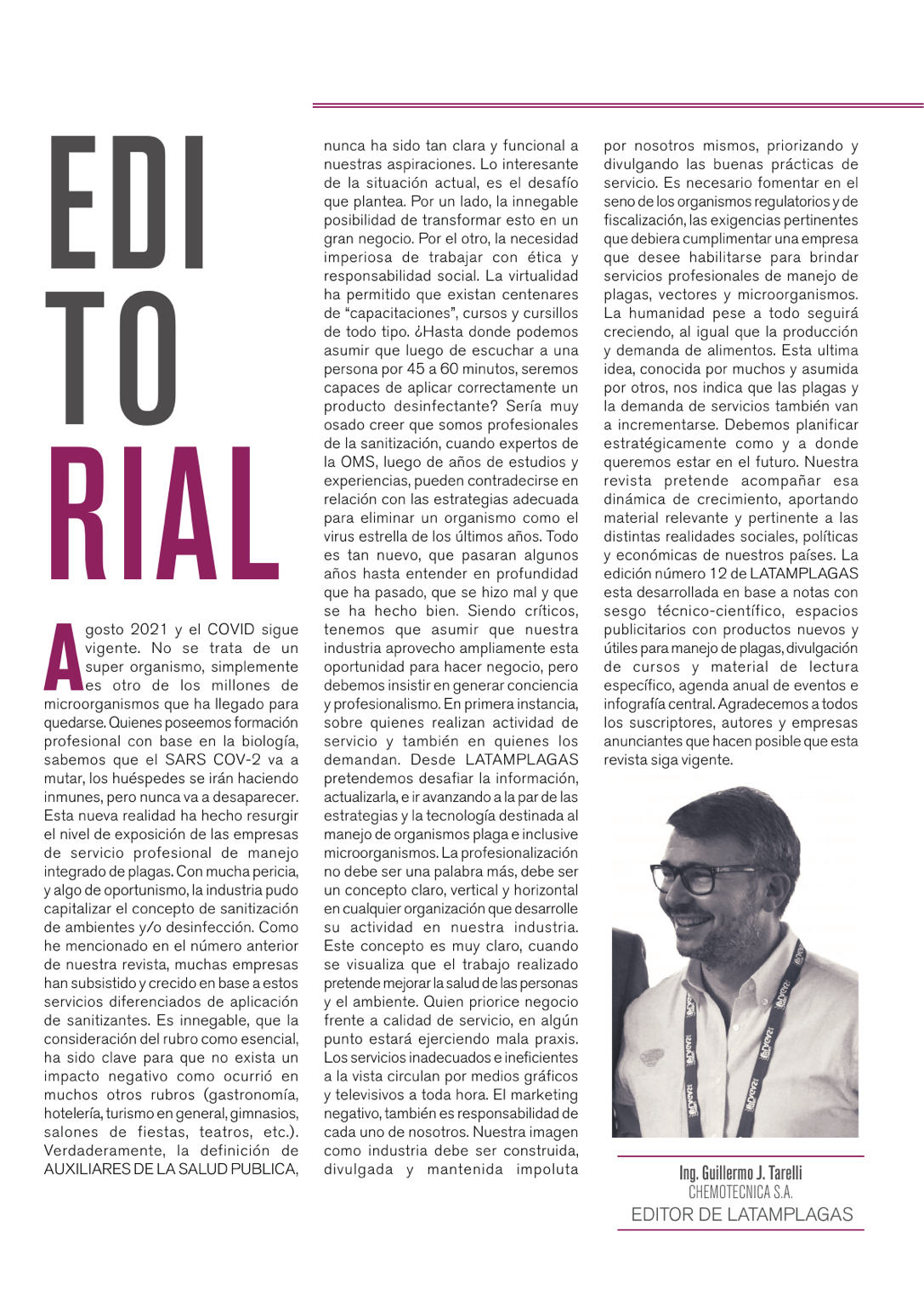
Ing. Guillermo J. Tarelli