
How to avoid resistance? Alternative insecticides in vector control
Malaria in the Americas, also called Malaria, continues to be a disease of great importance in Public Health, this parasitic disease caused by various species of the protozoan of the genus Plasmodium and its...
 María Teresa de Jesús Ambriz Barajas · Issue 11


Listen to this article with your device’s voice.
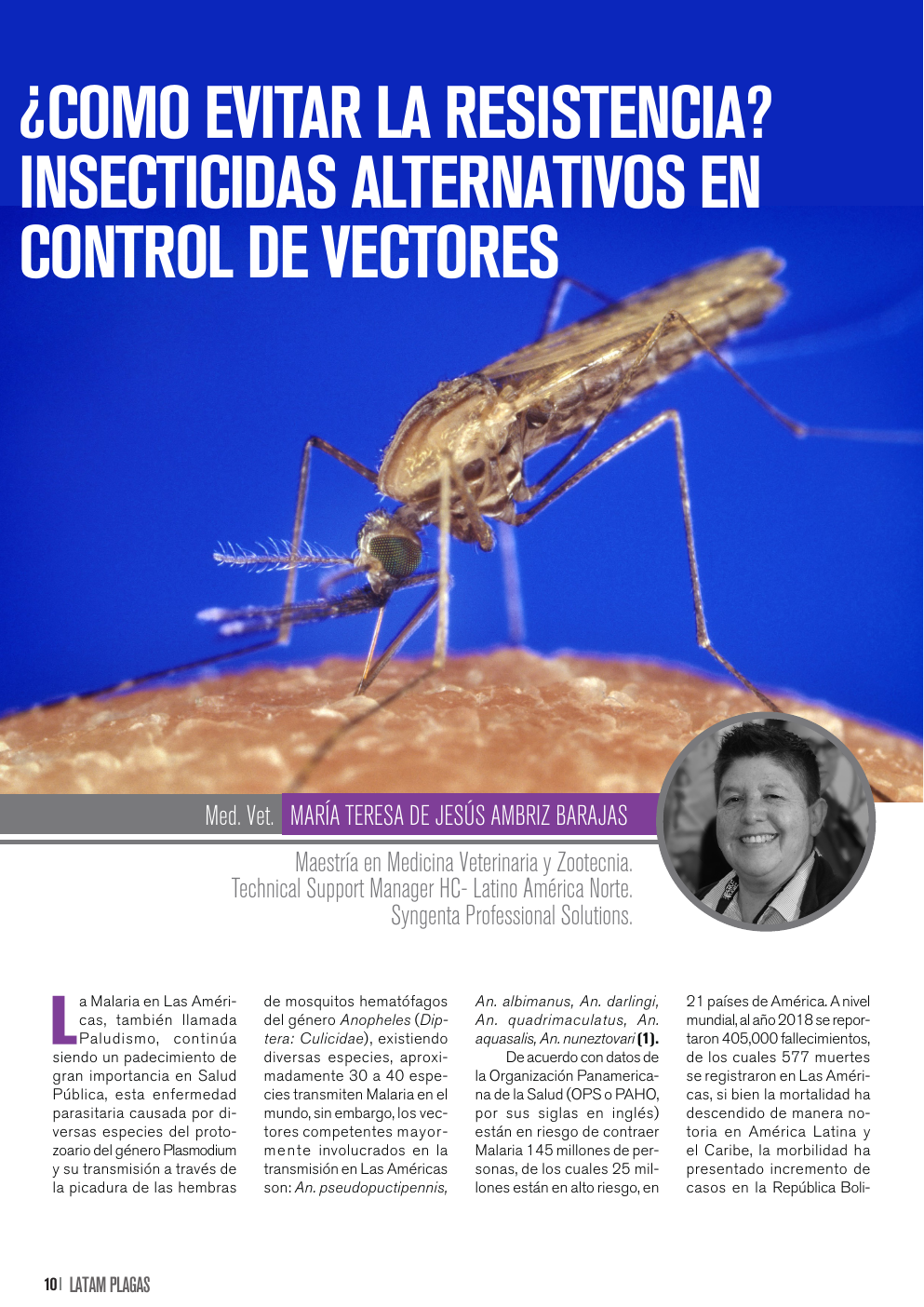
Malaria in the Americas, also called Malaria, continues to be a disease of great importance in Public Health, this parasitic disease caused by various species of the protozoan of the genus Plasmodium and its transmission through the bite of female hematophagous mosquitoes of the genus Anopheles (Diptera: Culicidae), there being various species, approximately 30 to 40 species transmit Malaria in the world, however, competent vectors are mostly involved in transmission in The Americas are: An. pseudopuctipennis,
albimanus, An. darlingi, An. quadrimaculatus, An. aquasalis, An. nuneztovari (1). According to data from the Pan American Health Organization (PAHO, for its acronym in English), 145 million people are at risk of contracting Malaria, of which 25 million are at high risk, in
21 countries in America. Worldwide, 405,000 deaths were reported in 2018, of which 577 deaths were recorded in the Americas, although mortality has decreased noticeably in Latin America and the Caribbean, morbidity has increased in cases in the Bolivian Republic of Venezuela (398,285 cases in 2019) and increased transmission in endemic areas of countries such as Brazil, Colombia, Guyana, Nicaragua and Panama. The consequences of Malaria are devastating for the patient, their family and for the economy of the countries (2,3,4). In addition to the above, there are biological challenges in the fight against Malaria, such as the failure to detect cases, due to the suppression of the pfhrp2 and pfhrp3 (pfhrp2/3) genes of the parasites that cause it, which make them undetectable by the rapid diagnostic test (RDT), resulting in false negative diagnoses, which has been reported in Peru. Additionally, the identification of resistance in the Plasmodium falciparum parasite to antimalarial drugs, such as sulfadoxine, pyrimethamine, chloroquine, mefloquine, atovaquone, artemisinin, and resistance to insecticides from various chemical families in mosquito populations of different species, are a handicap for Public Health (5,6). In contrast, investment in programs for the eradication of Malaria barely reaches a 30% participation of the governments of countries with an endemic situation; the largest financing is external, by international financiers such as the USA, the United Kingdom and foundations, which is still insufficient, since more than 5.1 billion dollars are required per year (3). Unfortunately, intra-household residual spraying (RRI or IRS, for its acronym in Spanish)
English) has decreased since 2010 in some countries, due to the possible change in health strategy or budgetary issues, since the resistance identified for some pyrethroids has implied a significant cost and the need to monitor resistance and implement the rotation of insecticides by different mode of action for the management of resistance (5). Unfortunately, it is estimated that the impact of COVID19 in the Americas, due to the disruption in the provision of services and Public Health interventions, will significantly affect the actions of detection and early treatment of cases and vector control campaigns, causing an increase in the transmission and occurrence of cases (4). On the other hand, the global problem of Dengue Fever, a serious disease caused by an arbovirus and its four serotypes, transmitted by Aedes (Stegomyia) aegypti (Diptera) mosquitoes. Culicidae), is increasing silently and it is estimated that 3.9 billion people, from 128 countries, are at risk of becoming infected and morbidity reaches 390 million per year in the world, of which 500,000 or more illnesses in the same space and time) between COVID-19 and Dengue is high in some regions, which complicates early diagnosis and timely anti-vector actions.
RESISTANCE TO INSECTICIDES NEGATIVELY IMPACTS THE CONTROL OF MOSQUITO VECTORS AND CONSEQUENTLY ON PUBLIC HEALTH, IN ADDITION TO AFFECTING THE ECONOMY OF A COUNTRY. Approximately four people suffer from severe dengue, require hospitalization and 2.5% die. In 2019, 5 million cases were reported worldwide (7.8). In the region of the Americas, in epidemiological week 52, 2,247,385 cases were reported, with 987,528 confirmed, with Brazil and Mexico being the countries that led the statistics(8). Since 2020, the risk of syndemic (convergence of
in addition to the risk of collapse of health systems (9). Malaria-transmitting mosquitoes, as well as Dengue Fever-transmitting mosquitoes, have developed different resistance mechanisms to insecticides from various families or chemical classes that have been used in health campaigns for vector control, for which the World Health Organization has established specific strategies for Integrated Vector Management (IVM) and the Management of Insecticide Resistance, together with the Insecticide Resistance Action guidelines. Committee (IRAC). A holistic vision that integrates several methods, with adulticidal chemical control with insecticides being part of the IVM. For decades, part of the strategy in the control of anopheline mosquitoes, transmitters of Malaria, has been adulticidal chemical control through residual spraying (IRS), that is, spraying or aspersion, using insecticides from the four families or chemical classes: organochlorines such as DDT (now out of use), organophosphates, carbamates and pyrethroids and the use of long-lasting mosquito nets impregnated with pyrethroids. (LLINs). During the period 2010-2018, resistance to at least one of the insecticides used to control mosquitoes was reported in the countries where the disease is endemic and in 26 of these countries there is already identified resistance to the four chemical classes, with resistance to some pyrethroids being the most distributed.
The definition of resistance by the Insecticide Resistance Action Committee (IRAC) expert group is “the selection of a heritable characteristic in an insect population that results in the repeated failure of an insecticide product to provide the desired level of control when used as recommended” (10), which is why it is inherited from generation to generation in mosquito populations and this is due to selection pressure on a given population with an insecticide or chemical family of insecticides through repeated use… sometimes by abuse in its use for very long periods without carrying out rotation strategies by modes of action. The IRAC defines four categories or mechanisms of resistance to insecticides(10), some mosquito populations may present more than one of them, so for the correct monitoring of resistance to insecticides it is important to use WHO evaluation methods with impregnated ballots, the CDC bottle bioassay method and additionally biochemical and PCR (polymerase chain reaction) tests, to evaluate if there is resistance to different active ingredients, in what magnitude or degree it is present in that population of mosquitoes. (Frequency of resistance) and what resistance mechanisms are involved. The “Global Plan for Insecticide Resistance Management in Malaria Vectors” (GPIRM) includes technical recommendations to avoid insecticide resistance such as:
- Plan and implement insecticide resistance management strategies in malaria-endemic countries,
- Try to ensure adequate and timely entomological and resistance monitoring, as well as effective data management,
- Create innovative vector control instruments,
- Fill gaps in knowledge on the mechanisms of insecticide resistance and on the effects of current management approaches on insecticide resistance (11).
Likewise, in the “Plan of action on entomology and Vector control 2018-2023” the “Five pillars of the strategy” have been defined, based on the management of resistance (12). Figure 1. The five pillars of the Global Plan for the Management of Insecticide Resistance in malaria vectors (12).
Resistance to insecticides negatively impacts the control of mosquito vectors and consequently on Public Health, in addition to affecting the economy of a country. It is important to preserve and recover susceptibility to insecticides approved for vector control with scientific strategies for rotation through different modes of action, since the investment in research and development to have new molecules and formulations on the market implies an approximate cost of 250 million dollars and 10 to 12 years between synthesis, evaluation, registration in different countries and WHO prequalification for vector control (13). Syngenta is one of the main global agrochemical companies present in 90 countries and actively participates in Public Health, in the fight against Malaria and other vector-transmitted diseases, such as Dengue, investing millions of dollars in research and development. Syngenta in association with the “Innovative Vector Control Consortium” (IVCC) of the Liverpool School of Tropical Medicine, with the support of the “Bill & Melinda Gates Foundation" and in coordination with the Roll Back Malaria program of the World Health Organization, managed to design Actellic® 300CS, a new tool for the management of resistance to pyrethroids, carbamates and other organophosphates. Syngenta obtained the official recommendation of the World Health Organization in 2013 for Actellic® 300CS and it was launched on the market in 2015 (14). Actellic® 300CS is a long residual insecticide classified as “3rd Generation Indoor Residual Spraying (3GIRS)” that is very useful for the strategies of the “Global Plan for Insecticide Resistance Management in Malaria.”
Vectors" (GPIRM) of the WHO and the "ZERO by 40" strategy of the Bill & Melinda Gates Foundation and the IVCC. Actellic® 300CS, contains Pirimifós methyl, a heterocyclic type organophosphate with a very wide safety margin, belonging to IRAC rotation group 1 B, in a "Capsule suspension" (CS) formulation, also called microencapsulated. This novel formulation is based on the patent
iCAP® from Syngenta, which protects Pirimifós methyl from degradation by ultraviolet light, changes in ambient humidity and the pH of the surfaces where it is applied, allowing prolonged residuality of at least 4 to 6 months on the treated surfaces, achieving effective and efficient control of mosquitoes, since a single annual application reduces the costs of residual spraying. Actellic® 300CS microcapsules, designed by Syngenta, have the perfect size for easy adhesion to the exoskeleton of mosquito vectors and other arthropods of importance in Public Health. The World Health Organization has evaluated Actellic® 300CS under the new scheme and it has been included in the Prequalification Vector Control List: PQT-VC Reference: 012-001 Date of Prequalification: 01/29/2018 (15). In 2018, its successful use in 32 African countries reduced costs and Malaria cases by up to 61% and 64% in Ghana and Mozambique, respectively. In 2018, the use of Actellic® 300CS in 30 African countries saved the lives of at least 34 million people. A recent study for Actellic® 300CS, published
in Nature Research (Scientific Reports, 2020), cites 10-month residuality on concrete and mud surfaces, achieving control of An. funestus and An. arabiensis with a single annual intervention in Kenya (16). In Mexico, Peru, Brazil, the Dominican Republic and Venezuela, prolonged residuals of at least 4 months have been obtained on different types of surfaces, for different species of mosquitoes: An. albimanus, An. pseudopuctipennis, An. darlingi, An. aquasalis, Aedes aegypti and Culex quinquefasciatus. In Peru it has demonstrated its effectiveness with 4 months of residuality in the control of An. darlingi, for the management of resistance to pyrethroids in areas of the Department of Loreto. In Mexico it is mainly used to control Aedes aegypti mosquitoes, as part of the IVM for Dengue and has also been evaluated for the control of triatomine vectors of Chagas disease and highly toxic scorpions (scorpions) Centruroides limpidus, using the same dose indicated for mosquitoes. The dose authorized by the WHO for this new microencapsulated formulation of Pirimifós methyl is 1 gram of active ingredient per square meter for residual intra-domiciliary spraying (IRS) and the safety margin is very wide, its toxicological category is WHO Class U: “Unlikely to represent hazard in normal use” and category 5, green band, of the Global Harmonized System (GHS). Actellic® 300CS mixes easily with water and it is recommended to apply according to the WHO technique with a Hudson X-Pert spray pump or equivalent and 8002E flat fan nozzle. It is important to highlight the great contribution to the control of Dengue, in 2019 the “Manual for applying indoor residual spraying in urban areas for the control of Aedes aegypti” was published by the Pan American Health Organization (PAHO), with modifications to the traditional method of residual indoor spraying and this manual includes the use of Pirimifós methyl. This new method is called “RRI for the urban control of Aedes” (RRI-Aedes), it focuses on the mosquito resting places and optimizes operation and control by applying it in a focused manner on the lower half of the walls, but maintaining the recommended dose for Pirimifós methyl of 1 gram of active ingredient per square meter (17). Actellic® 300CS is now available in Latin countries: Mexico, Peru, Brazil, Dominican Republic (Taritus® 300CS brand) and Bolivia. For more information see https: // www. syngentappm. com/product/crop-protection/vector-control/actellicr300cs, https: //www. syngentappm. com/vector-control, as well as to the technical area of Syngenta Professional Solutions and authorized distributors.
Literature. 1. Kiszewksi et al. , 2004. Global Distribution (Robinson Projection) of Dominant or Potentially Important Malaria Vectors. American Journal of Tropical Medicine and Hygiene 70(5): 486-498 2. World Health Organization. 2019. World Malaria Report 2019. Geneva. Swiss. (Cited 2021 February 15). Available at URL: https://www. who. int/publications/i/ item/9789241565721 3. Pan American Health Organization. 2021. (Internet site). Malaria in the Americas (Cited 2021 February 15). Available at URL: https://www. paho. org/ hq/dmdocuments/2013/ malaria-2013-fs-spa. pdf 4. Pan American Health Organization. 2021 (Internet site). Epidemiological Update: Malaria in the Americas in the context of the COVID-19 pandemic. June 10, 2020. (Cited 2021 February 15). Available at URL: https://www. paho. org 5. World Health Organization. 2021. (Online site). Malaria. The World Malaria Report 2019 at a glance. December 4, 2019 (Cited 2021 February 15). Available at URL: https://www. who. int/malaria/media/world-malaria-report-2019/es/ 6. Mace KE, Arguin PM, Lucchi NW, Tan KR. 2019. Malaria Surveillance -United States, 2016. MMWR Surveill Summ 2019; 68(No. SS5): 1–35. 7. Malaria Consortium. 2021.
(Internet site). Webinar: Mosquito-borne arboviruses: The rising global threat. (Cited 2021 February 18). Available at URL: https://www.malariaconsortium. org/pages/webinars/webinar-mosquito-borne-arboviruses-the-rising-global-threat.htm
of WHO for the Americas Plan of action on entomology and Vector control 2018-2023. CD56/11. (Cited 2021 February 18). Available at URL: https:// iris.paho.org/bitstream/handle/10665.2/49612/CD56-11-e.pdf?sequence=1&isAllowed=y
8. Pan American Health Organization. 2021. (Internet site). Reported cases of Dengue Fever in The Americas. (Cited 2021 February 18). Available at URL: https://www.paho.org/ data/index.php/en/mnu-topics/indicadores-dengue-en/ dengue-nacional-en/252dengue-pais-ano-en.html?start=1
13. Innovative Vector Control Consortium. 2021. (Internet site). New Product Development. (Cited 2021 February 18). Available at URL: https://www.ivcc.com/research-development/insecticide-discovery-and-development/
9. Cruz JPS, Tovilla-Zárate CA, González-Morales DL, González-Castro TB. Risk of a syndemic between COVID-19 and dengue fever in southern Mexico. Gac Med Mex. 2020;156(5):460-464. 10. Insecticide Resistance Action Committee. 2021. (Online site). Prevention and Management of Insecticide Resistance in Vectors of Public Health Importance (Cited 2021 February 18). Available at URL: https:// irac-online.org 11. World Health Organization. 2012. Global plan for insecticide resistance management in malaria vectors (GPIRM). Geneva, Switzerland. 130 pp. 12. Pan American Health Organization. 2018. (Internet site). 56th Directing Council 70th Session of the Regional Committee
14. Syngenta Crop Protection AG. 2015. Syngenta announces malaria insecticide entering early development phase. Joint media release. 2 pp. 15. World Health Organization. 2021. (Internet site). Prequalification Vector Control. (Cited 2021 February 18). Available at URL: https://www.who.int/pq-vector-control/prequalified-lists/ actellic_300cs/en/ 16. Abong’o, B., Gimnig, J.E., Torr, S.J. et al. 2020. Impact of indoor residual spraying with pirimiphos-methyl (Actellic 300CS) on entomological indicators of transmission and malaria case burden in Migori County, western Kenya. Sci Rep 10, 4518. 17. Pan American Health Organization. 2019. Manual for applying indoor residual spraying in urban areas for the control of Aedes aegypti. Washington, D.C. 57 pp.