
Exclusion: preventing entry before having to control
Andy Linares proposes intervening on entry pathways before an infestation can ever take hold.
 Andy Linares · Issue 20


Listen to this article with your device’s voice.
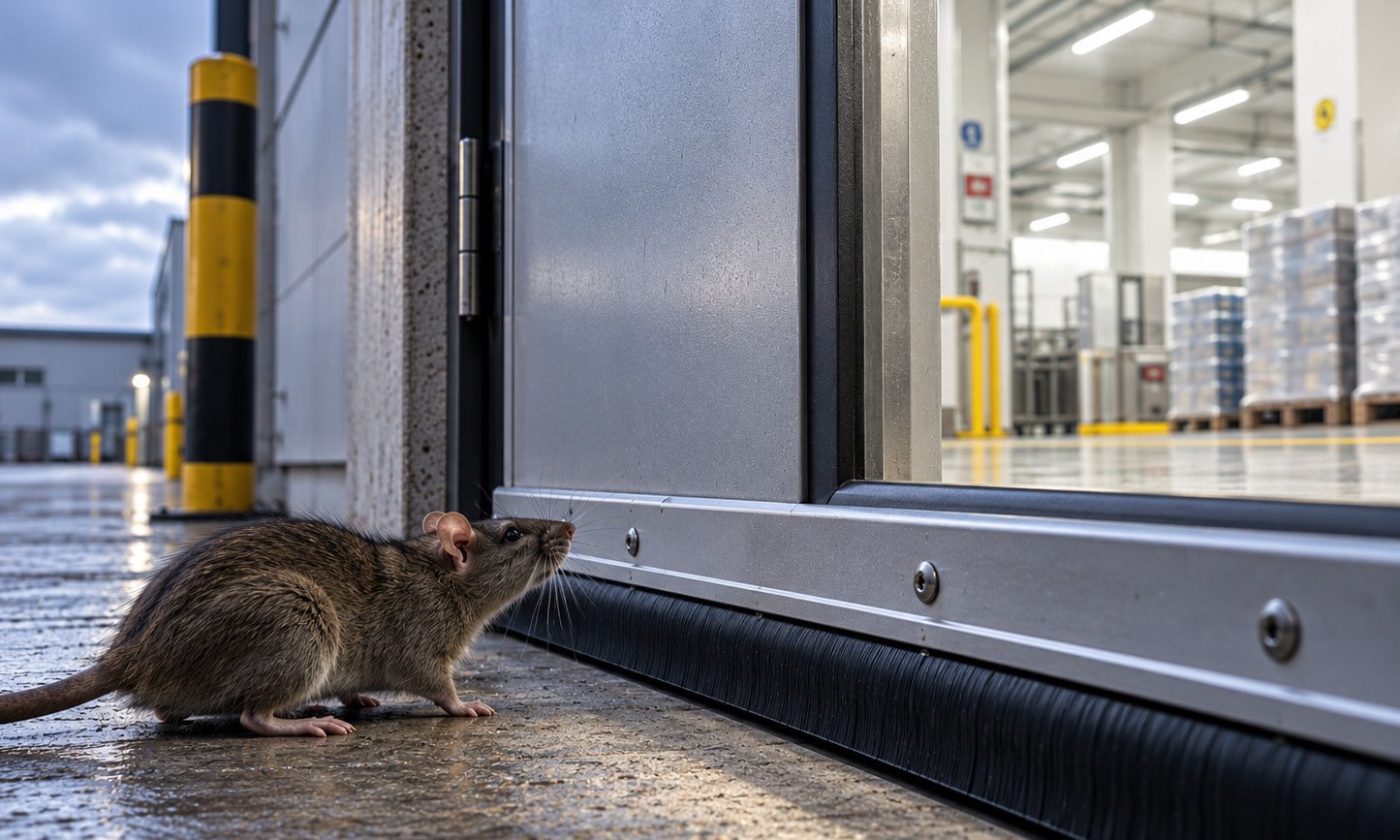
In professional pest management, much of the effort is often concentrated on controlling rodents once the problem is already present. Traps, baits, and rodenticides are fundamental tools within management programs, yet they all share one thing in common: they begin to act only after the rodent has managed to enter the structure.
Exclusion proposes intervening one step earlier. There is a phrase that sums up this idea very well: “If they can’t get in, they can’t become a problem.”
Exclusion consists of identifying, correcting, and sealing all potential entry points that rodents could use to gain access to a building. When these actions are combined with sound sanitation and housekeeping practices, it becomes possible to significantly reduce reliance on traps and rodenticides and move toward more sustainable, permanent solutions.
This concept entails a major shift in how we think about Integrated Pest Management. Instead of waiting to detect activity before taking action, we work on the structural conditions that could allow that activity to appear in the first place.
Why is it so difficult to keep them out?
To understand the importance of exclusion, it is first necessary to understand the adversary.
Rodents are natural explorers. They constantly search for food, shelter, and new opportunities. Their intelligence, curiosity, and adaptability make them extraordinarily efficient at finding entry points.
Furthermore, their anatomy reinforces this capability.
Their snout allows them to dig, probe, and lift materials. Their incisors can gnaw through and perforate a wide range of surfaces. Their tubular body makes it easy to squeeze through extremely narrow gaps, while their whiskers (vibrissae) and other sensory hairs gather environmental information used to make decisions during exploration. Consequently, an opening that may look insignificant to a person can quickly become an active entry route.
When conducting an exclusion-oriented inspection, one should not look solely for large holes or obvious structural defects. It is equally necessary to identify small vulnerabilities and assess whether a rodent could exploit them to enter. Exclusion is prevention; everything else is control.
This is one of the fundamental distinctions that must be understood when designing a rodent management program:
Exclusion is prevention; everything else is control.
When a trap or bait station is placed, action is being taken against an animal that has already succeeded in getting inside. Exclusion, by contrast, seeks to eliminate the problem at its source: preventing that entry from ever occurring.
This is especially important because once a rodent enters a facility, the problem is not limited to its physical presence alone.
One must also account for contamination through droppings, urine, hair, saliva, and other biological residues; the introduction of ectoparasites; structural damage and potential fire hazards from gnawed wiring; and the complications arising from decaying carcasses and secondary insect infestations.
Preventing entry therefore means preventing a large share of these associated problems before they can ever occur.
This logic takes on particular importance in sensitive facilities such as hospitals, schools, food processing plants, and multi-family residential buildings.
Everything begins with a thorough inspection.
An exclusion program does not begin with a sealant, a door sweep, or a repair.
It begins with an inspection. Before physically intervening on a structure, it is necessary to understand how rodents could gain entry, where the vulnerable points lie, and how the animals interact with the surrounding environment.
When inspecting the exterior of a building, one of the first aspects to evaluate is every utility penetration entering the structure. Pipes, conduits, cables, ventilation ducts, and expansion joints can create gaps that end up functioning as entry points.
It is also necessary to observe what is happening around the building. Nearby vegetation can provide harborage and create access pathways, so overhanging trees, shrubs, and adjacent plantings must be part of the assessment.
Yet the inspection does not end at the perimeter.
It is also essential to understand how rodents move inside a structure. To do so, both horizontal and vertical travel routes must be considered.
Rodents leave clues behind. The professional’s job is to learn how to read them. Those signs make it possible to reconstruct travel paths, recognize active zones, and pinpoint the critical vulnerabilities that must be corrected.
Ultimately, a good inspection requires looking at the building from the rodent’s perspective.
Seeing what happens when no one is watching.
Technology provides increasingly valuable tools to improve this process. Wildlife and monitoring cameras, for example, make it possible to document entries and exits, record travel routes, observe how rodents interact with specific devices, and continuously monitor hard-to-reach areas.
This significantly transforms diagnostic capability.
A traditional inspection reveals what is present at a specific moment in time. A camera, by contrast, can show what happens when no people are present.
In addition to providing objective evidence, these tools save operational time and maintain round-the-clock surveillance throughout the year.
Technology does not replace the professional’s experience. On the contrary, it supplies additional evidence to accurately interpret a situation and make better decisions.
It is not simply about plugging holes
Once vulnerable points have been identified, another critical stage begins: deciding how to resolve them.
And here an important concept emerges: performing exclusion does not simply mean plugging holes. Every opening has different characteristics. The substrate material, gap size, location, weather exposure, and structural movement all determine which solution is most appropriate.
The effectiveness of exclusion depends on selecting suitable materials, installing them properly, and treating each intervention as a permanent engineering solution complemented by periodic follow-up.
Among the available alternatives are reinforced door sweeps, such as Roban Guard systems, which combine durable rubber with steel strips to protect doors and other vulnerable access points. They are especially useful on double doors, loading bays, garages, and high-traffic areas.
There are also composite sealants, such as Roban Barrier, designed for cracks and openings up to two centimeters wide. This non-toxic paste reinforced with metal fragments cures externally while remaining flexible inside, allowing it to be used both indoors and outdoors under demanding weather conditions.
For larger voids and crevices, alternatives such as Roban Blocker—made from synthetic fibers interwoven with stainless steel—provide a flexible, durable barrier even in harsh environments.
Alongside these specialized products, traditional building materials such as concrete, sheet metal, and hardware cloth remain valid solutions whenever structural characteristics require them.
What matters is not having a single product expected to solve every situation, but accurately diagnosing each vulnerability and applying the right solution.
A discipline that continues to grow
Exclusion is occupying an increasingly prominent place within professional pest management and still has ample room for growth. Its expansion can also be seen in the scientific and academic spheres. Institutions and organizations such as Cornell University, the New York State Integrated Pest Management Program, the University of Minnesota, and the Scientific Coalition on Pest Exclusion (SCOPE) have contributed to developing research, standards, and best practices specifically focused on this discipline.
Over the coming years, stronger demand for these services is expected, along with more training programs, new specialized tools, and growth in dedicated exclusion divisions within pest management companies.
This also represents a major opportunity for the industry.
Exclusion broadens the professional value proposition. It is no longer just about arriving at a facility, knocking down a population, and servicing monitoring stations. The service can encompass vulnerability assessments, structural improvement proposals, professional installation of exclusion barriers, and ongoing verification.
In this way, exclusion becomes a specialized service capable of delivering lasting value to both the client and the pest management company.
The fundamental question changes.
Instead of asking only “how do we control the rodents that are already here?”, we must incorporate another question:
“How did they get in here, and what can be done to keep them from entering again?”
Prevent before controlling
For a long time, rodent control was closely associated with bait stations, traps, and rodenticides.
All of those tools remain important.
Yet Integrated Pest Management compels us to broaden our perspective.
The structure itself is part of the program.
A door that fails to seal tightly, a gap around a pipe, a deteriorated expansion joint, or a seemingly minor opening can ultimately determine the success or failure of a preventive strategy.
For that reason, exclusion must be viewed not merely as a supplementary task, but as a foundational component of rodent management programs.
In a context where clients increasingly seek sustainable, long-term solutions, this strategy delivers better outcomes while developing higher-value specialized services. Before deciding which trap to place or which control product to use, a much more basic question should guide the diagnosis:
Where are they getting in? Finding that answer and acting on it can completely transform the outcome of a rodent management program.
Because exclusion does not merely stop infestations.
It prevents problems before they begin.