
Pallets: a critical link in pest prevention and food safety
The modern food industry has developed sophisticated control systems to guarantee product safety across the entire production and distribution chain.
 Mirko Baraga · Issue 19


Listen to this article with your device’s voice.
The modern food industry has developed sophisticated control systems to guarantee product safety across the entire production and distribution chain. There are elements, however, that tend to go unnoticed despite being present in practically every logistics process. Among them are pallets — structures fundamental to the storage and transport of raw materials and finished products, but which can also become vehicles for the entry and spread of pests. Within an Integrated Pest Management (IPM) programme, pallets should be treated as a critical control point. Their constant circulation between suppliers, warehouses, distribution centres and industrial plants exposes them to multiple sources of biological contamination. For that reason, inspecting, selecting, cleaning and monitoring pallets is a preventive measure every bit as important as the pest control carried out inside the facility itself.
The pallet as a vehicle for contamination
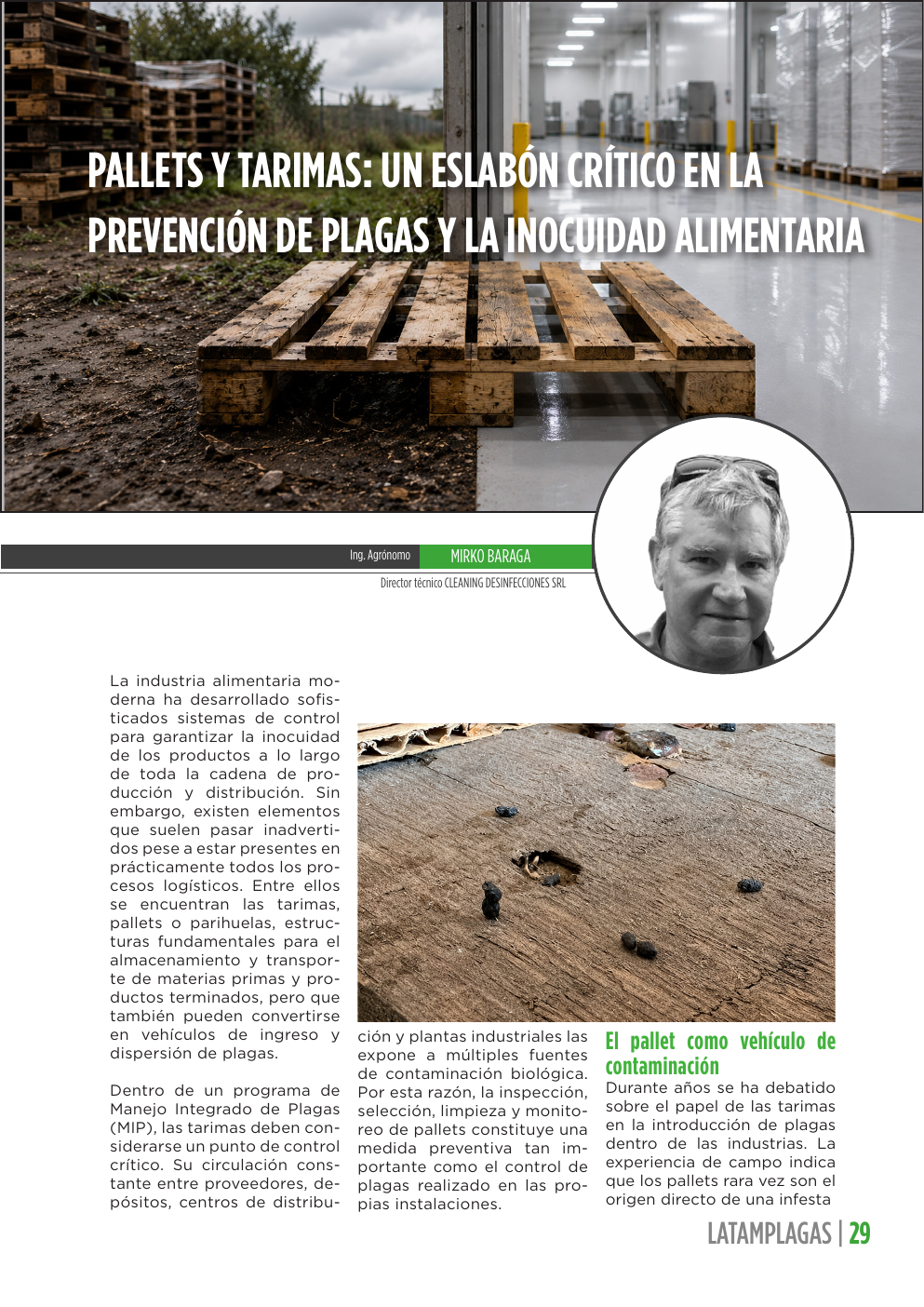
The role of pallets in introducing pests into industry has been debated for years. Field experience indicates that pallets are rarely the direct origin of an infestation. They can, however, act as temporary harbourage and as a means of transport for numerous organisms entering from contaminated environments. Evidence found during inspections includes rodent and bird droppings, cockroaches sheltering in structural cavities, occasional invasive insects and pests originating in stored products or in the transport vehicles themselves. In many cases the problem lies not in the pallet itself but in the storage conditions it was exposed to before reaching the plant. Various observations made in warehouses and logistics centres showed that contamination generally occurs when pallets are stored on bare ground, on vegetation or on surfaces exposed to moisture. Situations were also identified in which the contamination came from poorly maintained warehouses of origin or from vehicles with previous pest activity. Seen this way, the pallet works as temporary harbourage. It does not necessarily provide the conditions for the organisms to reproduce or survive for long, but it does allow them to move from one environment to another, increasing the risk of dispersal within the logistics chain.
The influence of the material
The material used to build pallets has a direct impact on their capacity to harbour contaminants and on how easily they can be cleaned. Wooden pallets remain the most widely used worldwide because of their low cost and ready availability. From a hygiene point of view, however, they have significant limitations. The porosity of wood encourages moisture absorption and the retention of organic residues. Cracks, joints and internal cavities also create potential harbourage for insects and other organisms. Plastic pallets, by contrast, have smooth surfaces that make washing easier and reduce the build-up of dirt. Their resistance to moisture and to many chemical agents makes them a particularly attractive alternative for the food and pharmaceutical industries. Aluminium pallets represent the highest level of hygienic performance. They are highly durable, easy to clean and offer virtually no spaces for pests to shelter in. Their high cost, however, limits their use to specific operations where hygiene requirements justify the investment. Although the choice of material matters, no pallet can be considered safe unless it forms part of a proper inspection and maintenance programme.
Inspection as the first preventive barrier
One of the main objectives in managing pallets is to keep contaminated materials out of production and storage areas. Inspection should therefore begin even before the load enters the facility. The assessment must cover both empty and loaded pallets, and also the transport vehicles and the areas where pallets are stored. This review makes it possible to detect early signs of contamination and to take decisions before the problem enters the plant. Certain conditions justify rejecting a pallet immediately. These include the presence of bird or rodent droppings, adhering organic residues, hydrocarbon contamination, excessive moisture, unusual odours, remains from health seizures, or any evidence suggesting possible biological or chemical contamination. The presence of rodent droppings is particularly critical. Such a finding not only indicates recent activity but may also represent a microbiological risk to the products being carried. In a situation of this kind, the recommendation is to inspect the entire load and to consider whether the whole consignment should be rejected.
Do all pallets need disinfecting or treating for insects?
A frequent question within the industry is whether pallets should receive systematic disinfection or insect treatments. Accumulated experience in industrial operations shows there is no conclusive evidence attributing food contamination events directly to a pallet that had previously been inspected and cleaned. For that reason, proper selection and mechanical cleaning are usually the most important measures in the prevention process. Where operating conditions require it, however, complementary treatments can be applied. Physical cleaning with brushes, scrapers or vacuum cleaners removes organic remains and accumulated dirt. Where a microbiological risk exists, disinfection procedures can then be applied using agents such as sodium hypochlorite, alcohols, ozone or chloramine-T based formulations. These treatments aim to reduce the load of bacteria, fungi and viruses on the pallet surface. For insect control, liquid contact insecticides can be applied by medium-pressure spraying. Aerosols, fumigants or treatments in confined spaces are also used, depending on the level of risk identified.
Heat treatment and preventive control
Among the options available for sanitising pallets, heat treatment holds a prominent place. Exposing wood to temperatures of at least 56 °C for thirty minutes or more eliminates numerous organisms associated with the material without leaving chemical residues. This procedure is widely used internationally because of its effectiveness and its compatibility with food safety programmes. Where residual protection against crawling insects is needed, specific insecticide formulations can be applied to stacks of stored pallets. The experience presented here highlights the use of fipronil-based formulations for their low odour, rapid drying and long residual action on wooden surfaces. Any chemical application must nevertheless comply with current regulations and always take into account the particular requirements of each industry.
Correct storage: a frequently underestimated measure
Many hygiene problems associated with pallets originate in poor storage practice. Stacking pallets near drains, on damp surfaces or out in the open encourages contact with insects, birds and rodents. Pallets should therefore be stored under cover, on firm surfaces and away from potential sources of contamination. It is also advisable to limit stack height so that inspections are easier and air circulates better around the structures. These simple measures considerably reduce the likelihood of pallets becoming temporary harbourage for unwanted organisms.
The importance of continuous monitoring
Initial inspection loses its effectiveness unless it is backed by an ongoing monitoring programme. Pallet stores are environments where species associated with stored products can be detected early, such as the Indian meal moth (Plodia interpunctella) or various beetles of the genus Tribolium. Systematic monitoring makes it possible to identify trends, assess how well the measures in place are working and act before an isolated situation turns into a larger infestation. Within a modern food safety strategy, early detection remains one of the most effective and economical tools for preventing financial loss and protecting product quality.
Conclusions
Pallets are far more than a logistics tool. They are a strategic component within the food safety and pest control programmes of any food business. While there is no evidence identifying them as directly responsible for food contamination events, they can act as a means of transport and as temporary harbourage for a range of organisms. Choosing the right material, inspecting on arrival, cleaning, storing correctly and monitoring continuously must therefore all form part of an integrated management system. Prevention remains the most effective measure. Understanding the part pallets play in the logistics chain makes it possible to reduce risk, strengthen Integrated Pest Management programmes and improve the safety standards the modern industry demands.