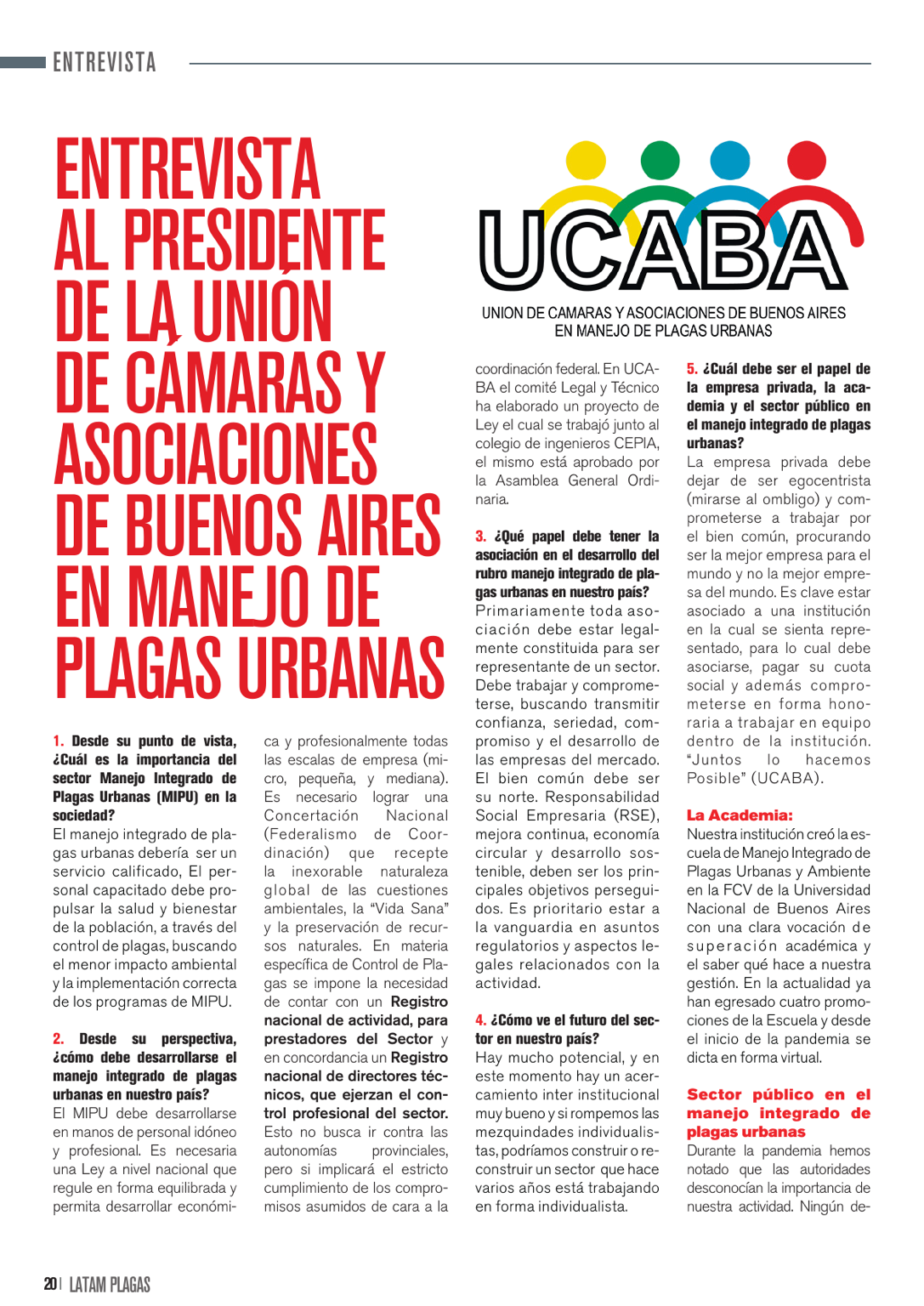
Interview with the president of UCABA
In your view, how important is the Integrated Urban Pest Management (IUPM) sector to society?
Technical summary
- Focus
- In your view, how important is the Integrated Urban Pest Management (IUPM) sector to society?
- Approach
- The article structures the analysis around 1. In your view, how important is the Integrated Urban Pest Management (IUPM) sector to society?, 2. From your perspective, how should integrated urban pest management develop in our country? and 3. What role should the association play in developing the integrated urban pest management field in our country?.
- Use
- Useful for professionals who need context, diagnosis and operational decisions in urban pests.
Index
- 1. Desde su punto de vista, ¿Cuál es la importancia del sector Manejo Integrado de Plagas Urbanas (MIPU) en la sociedad?
- 2. Desde su perspectiva, ¿cómo debe desarrollarse el manejo integrado de plagas urbanas en nuestro país?
- 3. ¿Qué papel debe tener la asociación en el desarrollo del rubro manejo integrado de plagas urbanas en nuestro país?
- 5. ¿Cuál debe ser el papel de la empresa privada, la academia y el sector público en el manejo integrado de plagas urbanas?
- JESÚS ROMERO
- PRESIDENTE UCABA
- ARGENTINA
1. In your view, how important is the Integrated Urban Pest Management (IUPM) sector to society?
Integrated urban pest management ought to be a qualified service. Trained staff should promote the health and well-being of the population through pest control, seeking the lowest possible environmental impact and the correct implementation of IUPM programmes.
2. From your perspective, how should integrated urban pest management develop in our country?
IUPM must be carried out by competent, professional staff. We need a national law that regulates the field in a balanced way and allows companies of every size — micro, small and medium — to develop economically and professionally. We need to reach a national accord (coordinated federalism) that takes on board the inescapably global nature of environmental matters, of “healthy living” and of the conservation of natural resources. In pest control specifically, there is a pressing need for a national register of activity covering providers in the sector and, alongside it, a national register of technical directors exercising professional oversight of the sector. This is not intended to work against provincial autonomy, but it will mean strict compliance with the commitments taken on with a view to
federal coordination. At UCABA, the Legal and Technical committee has drawn up a draft bill, produced together with the CEPIA association of engineers, which has been approved by the Ordinary General Assembly.
3. What role should the association play in developing the integrated urban pest management field in our country?
First of all, any association must be legally constituted in order to represent a sector. It must work and commit itself to conveying trust, seriousness and commitment, and to the development of the companies in the market. The common good must be its guiding star. Corporate social responsibility, continuous improvement, the circular economy and sustainable development should be its main objectives. Staying at the forefront of regulatory matters and of the legal aspects of the activity is a priority.
4. How do you see the future of the sector in our country? There is a great deal of potential, and at the moment there is very good inter-institutional rapprochement. If we set aside individualistic pettiness, we could build — or rebuild — a sector that has spent several years working in an individualistic way.
5. What role should private companies, academia and the public sector play in integrated urban pest management?
Private companies must stop being self-centred — navel-gazing — and commit to working for the common good, aiming to be the best company for the world rather than the best company in the world. It is essential to belong to an institution in which you feel represented: that means joining, paying your membership fee and also committing, on an honorary basis, to work as part of a team within the institution. “Together we make it possible” (UCABA).
Academia: our institution created the School of Integrated Urban Pest Management and Environment at the Faculty of Veterinary Sciences of the National University of Buenos Aires, with a clear vocation for academic advancement and for the knowledge that underpins our work. Four cohorts have now graduated from the school, and since the start of the pandemic it has been taught online.
The public sector in integrated urban pest management: during the pandemic we noticed that the authorities were unaware of the importance of our activity. No decree authorised IUPM companies to travel during lockdown, because they were not included among essential activities. Government bodies clearly did not understand the scope of what we provide. IUPM companies do not only manage pest organism populations; they also disinfect premises, clean and disinfect drinking water tanks, safeguard the safety and quality of the entire agri-food chain and of the pharmaceutical industry, and carry out sanitary control of vectors (such as the mosquito Aedes aegypti, which transmits dengue, Zika and chikungunya). When COVID-19 cases arise in hospitals, care homes, clinics, drug wholesalers, pharmacies, apartment buildings and so on, it is IUPM companies that carry out the sanitisation. Thanks to the work of UCABA's Legal and Technical committee and the institutional backing of FECOBA and CAME, we were able to reverse that lack of awareness among legislative and government authorities. It was demonstrated that the integrated urban pest management companies we represent are health agents auxiliary to public health — as evidenced by the latest presidential decree, DNU 2021-334 PNPTE, article 5, subsection 5, in which we were included and designated essential services for sanitisation, maintenance, fumigation and integrated pest management.