
Writing about pigeons is not forbidden; feeding them is
Marcelo Castillo reflects on urban pigeons, their history, coexistence conflicts, and management alternatives.
 Marcelo Castillo · Issue 20


Listen to this article with your device’s voice.
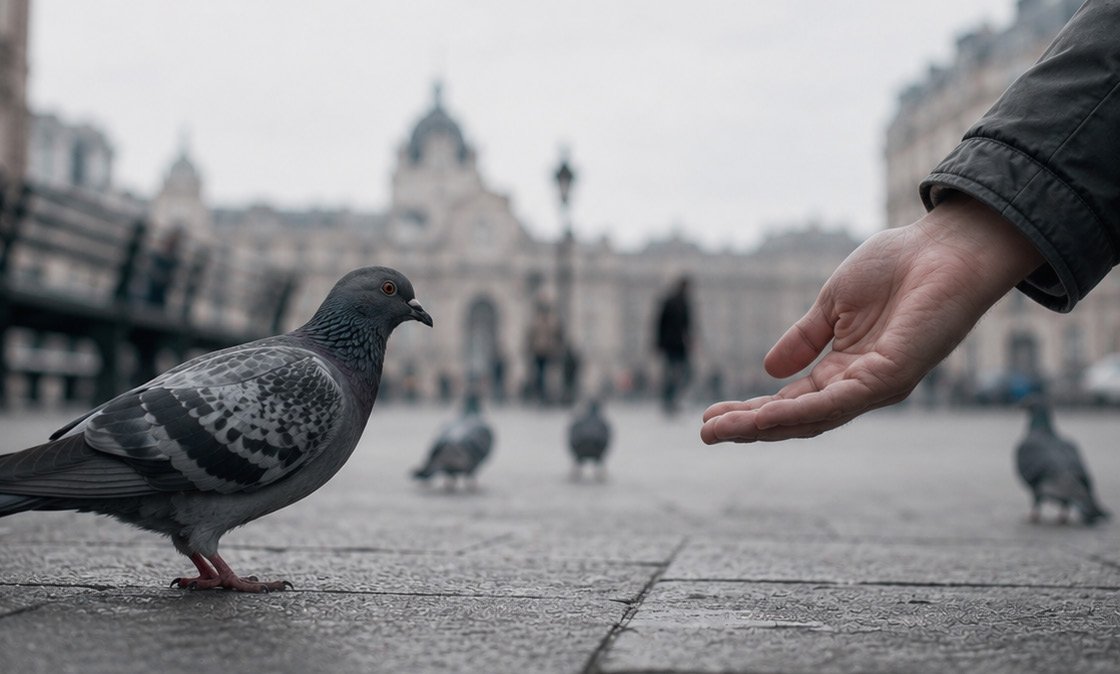
For this columnist, writing about pigeons is neither forbidden nor banned nor subject to a fine; on the contrary, I write on the one hand with the pen of a pest management professional and, on the other, from an animal-welfare, pigeon-fancier perspective, so to speak—from up high, like a bird perched on the ledge of a bell tower, alert and stealthy before any chance of sustenance to swoop down and eat from the hand of a lonely elder, from the hand of a mischievous, tender, and compassionate child, or from any mortal sitting on a park bench passing the time. For the pigeon will never bite the hand that feeds it; it grew accustomed to living among us because we taught it to do so. Pigeons did not invade cities; it was the cities that created them and invited them to stay, only to leave them abandoned to their fate.
How could we not recall Cher Ami (which in French means dear friend), a brave homing pigeon that saved the lives of many American soldiers during the First World War. She was the only pigeon still alive, the last hope, as all previous ones had been shot down by the Germans.
The message carried the coordinates of the Lost Battalion and read: “We are along the road parallel to 276.4. Our own artillery is dropping a barrage directly on us. For heaven’s sake, stop it.”
Amid the crossfire, the bird lost an eye, a leg, and suffered a chest wound; not in vain did she fly 40 km in 25 minutes to deliver the dispatch and stop the bombardment.
Ultimately, US Army medics amputated her leg and crafted a wooden orthopedic prosthesis for her; she lived and died as a heroine. After her death in 1919, her body was mounted and is preserved today at the National Museum of American History in Washington.
It is true that carrier pigeons inspired romanticism for centuries, representing the desire to send notes and keepsakes to a distant loved one. Afterward, they returned to their loft (colombophily) once the letters were delivered; in a bygone era, they were a classic symbol of love, peace, and happiness.
On the other hand, with the eye and pen of a pest management professional, I must admit they are no saints either—pardon the expression, they do not mind leaving their droppings mid-flight or while perched, and they transmit viral diseases to mammals and humans through direct contact with infected animals or simply through contaminated surfaces.
According to a specialized publication from 2007 authored by the late veterinarian Dr. Daniel González-Acuña, then a professor at the Faculty of Veterinary Medicine of the University of Concepción, Chillán campus, the study concluded that the species Columba livia could transmit more than 30 diseases to humans and another 10 to domestic animals. In terms of public health, according to the specialist, the most significant zoonoses are chlamydiosis, cryptococcosis, aspergillosis, salmonellosis, listeriosis, and staphylococcosis—ailments and illnesses transmitted through the air or through excreta.
But let us get to the point: many myths and truths surround these feathered creatures, from disparagingly calling them “rats with wings” to comparing them with everyday life examples in fables or proverbs. Some of the ones I remember best include: “There are people who are like pigeons: when they are on the ground they eat from your hand, but when they fly high they defecate on you,” or the fable of the pigeon playing chess: “Arguing with a fool is like playing chess with a pigeon. No matter how good you are at the game, the pigeon will simply knock over all the pieces, defecate on the board, and strut around as if it had won”; “acting like a white dove”; “scoring a diving header (gol de paloma)”; “so proud he puffs out his chest like a pigeon”; “watching Netflix eating popcorn (palomitas)”—there are many more, though they have flown from my imagination.
They have been present since biblical times, like the dove that returned to Noah’s Ark with an olive branch in its beak, announcing that the Almighty had ended the flood, or the one that appeared as the presence of the Spirit of God at the baptism of Jesus on the banks of the Jordan River.
Let us admit that in antiquity they were used as courier services, carrying vital information both in war and in love, although with the advance, progress, and development of new forms of communication, they were replaced by the telegraph, the telephone, the fax, the internet, and drones, definitely losing the romantic and novelistic fantasy in which pigeons delivered declarations and passionate letters.
They saved thousands of lives in armed conflicts; what is more, thanks to their remarkable sense of orientation, like true airborne GPS units, they were decorated with medals of honor for fulfilling their mission amid bullets. Sadly, however, they were abandoned and came to depend on human crumbs and waste, until even their right to bread was denied. They were important to humanity and later forgotten.
If we let our imagination take flight, they were a muse for songwriting: “Se equivocó la paloma” is the title of a poem written by Spaniard Rafael Alberti in 1941, set to music and performed by artists such as Joan Manuel Serrat and Mercedes Sosa. With a melancholic and simple tone, the lyrics describe a series of absurd confusions into which a dove falls when becoming disoriented—mistaking north for south, wheat for water, and the sea for the sky. Then there are “Paloma Blanca, Paloma Mía” by Spaniard Camilo Sesto; “Paloma Blanca” by French-Spanish singer Georgie Dann; “Yo fui paloma por querer ser gavilán” by Pablo Abraira; and “Cucurrucucú Paloma” by Pedro Infante, among many songs where pigeons and doves served as poetic inspiration for melodies that endured over time.
They were even depicted in art history on canvases such as Child with a Dove (1901), Pigeon with Green Peas (1911), and Dove of Peace (1949) in paintings by Pablo Picasso and other world-renowned artists.
Famous women even bear the name, such as Paloma San Basilio, Paloma Mami, and Paloma Picasso; and the former Colombian soccer player Albeiro “El Palomo” Usuriaga, who achieved his greatest sporting prominence at Club Atlético Independiente of Avellaneda, Argentina.
An important historical fact when writing about these birds concerns the Spanish pigeon lofts authorized by military authorities. Every year, a pigeon census was conducted and submitted to the Ministry of Defense; in the event of conflict, the Ministry could requisition them for military strategy and tactics. The army maintained a network of pigeon lofts, releasing birds at the front by parachute from airplanes. Soldiers recovered them, attached a message to one of their legs, and released them to fly back to base. Unfortunately, technology caught up with them and they were displaced by drones. The United States used them in Iraq, and the Belgian army also kept 10,000 pigeons, according to Eugenio Monesma’s documentary on YouTube.
Among the curiosities and reports in which they have featured—without going too far back in time—in 2022 news went viral about “zombie pigeons” on the island of Jersey in the United Kingdom. An avian paramyxovirus, a highly contagious pathology among them (though of low mortality), left neurological sequelae in the flock, including pronounced neck twisting, walking in circles, wing paralysis, and an inability to coordinate movement. Some misleading online commentary blamed 5G technology, a myth debunked by the scientific community. In any case, let us get back to the point and call things by their name: these times are not for romanticism or poetry or making history. Across the centuries, pigeons have been loved and hated—delicacies of haute cuisine in countries such as Spain, France, China, and the Middle East; items on the menu of birds of prey; symbols of hope used since ancient Greece and Rome to relay Olympic Games results and military strategies; the white dove with an olive branch as the universal archetype of peace, an inspiration in the biblical account of Noah, and in Christianity a symbol of the Holy Spirit.
As a brief conclusion, I believe times have changed and today they are considered urban pests—viewed with distaste, yet with respect—because they generate diverse health risks and structural damage coupled with serious hygiene problems. Their explosive proliferation affects both public health, due to the risk of disease transmission, and the integrity of buildings, due to the corrosion caused by their droppings.
Droppings and feathers can contain fungal spores that, when inhaled, may cause the diseases described above. Pigeons also act as hosts for nuisance and hazardous arthropods affecting humans, such as lice and mites that feed on blood and feathers; at times, these parasites can enter homes from nearby nests and bite people, acting as vectors of zoonotic diseases.
It must be made very clear that their droppings are highly aggressive due to the presence of uric acid, which deteriorates metals and corrodes different types of surfaces. In addition, feathers clog pipes, rainwater downspouts, and ventilation systems, which during winter consequently leads to flooding and roof damage; likewise, the accumulation of droppings on sidewalks or emergency exits creates slippery and hazardous surfaces for pedestrian traffic.
Now then, given everything stated above, let us say that pigeons are no saints, and among the aggravating factors working against them is the attraction of secondary pests: food scraps, food thrown into public spaces, and nests attract other harmful vectors such as rats and flies.
All things considered, with all the cards on the table and the brief background mentioned, I must note a piece of news from my hometown that went viral on social media when the municipality of Concepción, capital of the Biobío Region in Chile, led by Mayor Héctor Muñoz, took an unprecedented measure: enacting an ordinance that fines passersby between 70,000 and 375,000 Chilean pesos approximately (between 76 and 410 US dollars) for feeding pigeons or throwing them any kind of food—from bread crumbs and ice-cream cones to popcorn, whatever it may be—since overpopulation has increased exponentially in recent years.
According to sources from the family health centers (CESFAM), cases of lung disease caused by fungi accumulating in droppings have been reported, as explained by biologist Ximena Cortés, head of the municipality’s Department of Environment and Pest Control.
The campaign, titled “Do Not Feed Pigeons,” seeks to educate the community about the effects of feeding these animals in public spaces. In comparative terms, if we look beyond our borders, such ordinances also exist internationally: bans are in place across several European countries to protect architectural heritage from the acidity present in pigeon droppings.
For example, in several Spanish cities, feeding pigeons is penalized with fines that can reach up to 750 euros.
As a prime example, the famous St. Mark’s Square in Venice, historically known for its large pigeon population, had to restrict the sale of grain and ban feeding them in order to control their impact on monuments, heritage buildings, statues, and mosaics.
From an ethical standpoint, instead of mass culling, cities such as Berlin implemented pigeon loft (“pigeon hotel”) programs. In these shelters, the birds are fed and their eggs are replaced with plastic replicas to control birth rates.
Likewise, it is remarkable to note that in Bogotá, the capital of Colombia, there is a pigeon clinic or Pigeon Care Center (CAP), a model based on veterinary care, monitoring, and sterilization. The program seeks to prevent uncontrolled reproduction and maintain an appropriate population size in public spaces and squares that allows the birds to survive in the best possible conditions. The municipality of Bogotá, in partnership with Antonio Nariño University, sets a global example, as birds are continuously treated and subsequently released and reintegrated into local flocks.
According to El Espectador on Instagram, since this program was implemented, Plaza de Bolívar in Bogotá went from 2,200 pigeons in 2023 to 450 today. Notably, 40% of Bogotá’s pigeon population suffers from illness linked to harmful diets driven by garbage and decaying food, while artificial feeding causes excessive concentrations of birds in specific spots across the city.
In my view, the solution adopted by the municipality of Concepción could incorporate friendlier methods, since pigeons are part of urban biodiversity and the natural scenery of civic space—perhaps the use of a non-toxic contraceptive compound that interferes with egg incubation and fertility, mixed with corn or another feed and dispensed in controlled baiting, providing humane birth control that progressively reduces reproductive capacity and population size.
The hazards that exist on the streets for people can stem from multiple sources—from stray dogs, skateboards, and trees or utility poles falling during storms to many other factors that fall outside my scope of analysis and pen as a pest control professional.
In short, let us hope that the drastic ordinance enacted by the municipality of Concepción, which affects them directly by denying them bread, does not turn out to be a cure worse than the disease—driving birds on the brink of starvation, deprived of the sustenance they were used to receiving from human hands without biting them, to fly toward garbage dumps and waste sites, where they may contract an avian paramyxovirus that leaves them walking in circles with twisted necks, paralyzed wings, and uncoordinated zombie-like movements.
We will not be able to blame 5G technology, nor call them rats with wings, nor merely forbid feeding them, nor shift responsibility onto birds of prey—their natural predators—nor forbid writing about them. Because quite simply: writing about pigeons is not forbidden; feeding them is.
The images in this article were generated with artificial intelligence.