
Making invisible threats visible: poisoning and chronic chemical exposure in the home
The home as the main setting for exposure to hazardous chemical substances.
 Fernando Manera · Issue 19


Listen to this article with your device’s voice.
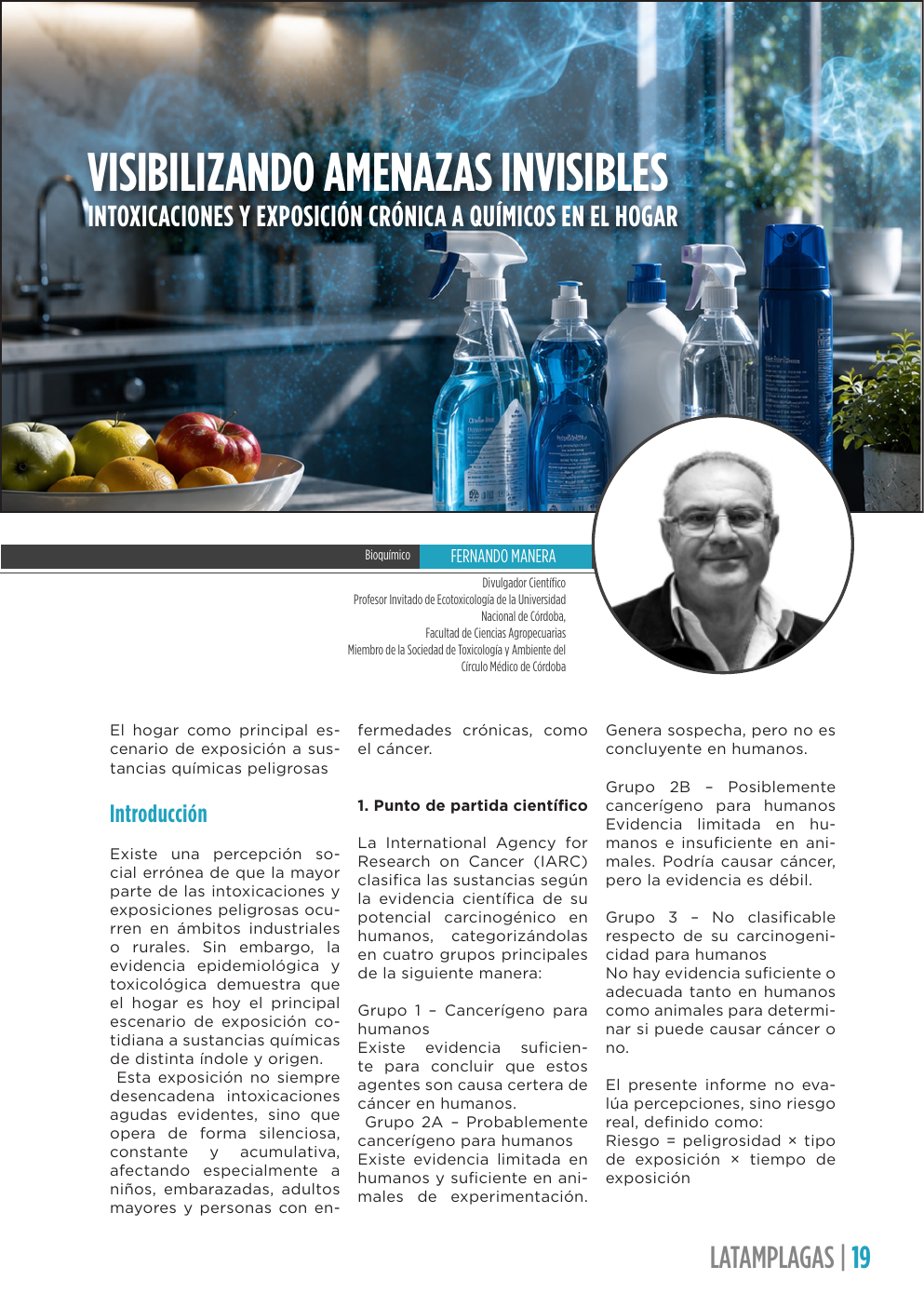
The home as the main setting for exposure to hazardous chemical substances
Introduction
There is a mistaken social perception that most poisonings and hazardous exposures occur in industrial or rural settings. Epidemiological and toxicological evidence, however, shows that the home is today the main setting for everyday exposure to chemical substances of every kind and origin. This exposure does not always trigger obvious acute poisoning; rather it operates silently, constantly and cumulatively, affecting children, pregnant women, older adults and people with chronic illnesses such as cancer in particular.
1. Scientific starting point
The International Agency for Research on Cancer (IARC) classifies substances according to the scientific evidence for their carcinogenic potential in humans, placing them in four main groups as follows: Group 1 – Carcinogenic to humans. There is sufficient evidence to conclude that these agents are a definite cause of cancer in humans. Group 2A – Probably carcinogenic to humans. There is limited evidence in humans and sufficient evidence in experimental animals. It raises suspicion but is not conclusive in humans. Group 2B – Possibly carcinogenic to humans. Limited evidence in humans and insufficient evidence in animals. It could cause cancer, but the evidence is weak. Group 3 – Not classifiable as to its carcinogenicity to humans. There is not enough or adequate evidence in either humans or animals to determine whether it can cause cancer. This report does not assess perceptions but real risk, defined as: Risk = hazard × type of exposure × duration of exposure
2. Chemicals present in the home
In the domestic environment we find numerous substances classified by IARC as Group 1 (135 of them), including:
- Asbestos (in fibre cement, old water tanks, pipe insulation)
- Formaldehyde (some nail varnishes, hairdressing products, cleaning products, cigarette smoke, industrial disinfectants, among others)
- Benzene (vehicle emissions, industrial solvents, waste burning, the petrochemical industry)
- Nitrosamines (such as meats cured with nitrites, ingredients such as DEA diethanolamine or TEA triethanolamine)
- Benzidine (azo dyes, certain dyed garments, industrial inks and paints)
- Furans associated with the burning of open rubbish dumps, the paper industry and pulp mills)
- Dioxins – TCDD (rubbish burning, mainly plastics and tyres, chlorine bleaching of paper, pulp mills and food, among others)
- Mycotoxins (produced by fungi: in food, damaged grain, flour, indoor environments with mould)
- Environmental tobacco smoke (active and passive smoking)
- Ethanol in alcoholic drinks (beer, wine, whisky, vodka and other commonly consumed drinks)
- Arsenic (including in drinking water in regions with arsenic-rich subsoil, HACRE – chronic endemic regional hydroarsenicism – and certain foods)
- Among others
Key characteristics of domestic exposure
- Continuous (hours, days, years)
- Without any protection
- In enclosed spaces
- Affects the whole family
- Includes children and pregnant women
- Numerous substances are IARC Group 1
3. Chemicals used in the field
Present-day agriculture uses only regulated plant protection products, previously assessed by multiple international agencies.
Key fact
In general, the plant protection products currently authorised are not classified as Group 1 by IARC. Some of them have been assessed as:
- Group 2A (probably carcinogenic)
- Group 2B (possibly carcinogenic)
- Group 3 (not classifiable)
Characteristics of rural exposure:
- Intermittent
- Controlled dose
- Regulated application
- Compulsory use of PPE
- Prior toxicological assessment
- Re-entry and pre-harvest intervals
The home as the main setting for constant exposure
Far from being a chemically safe space, the home has become the main setting for constant exposure to hazardous substances, including Group 1 carcinogens according to IARC. Modern poisoning is not always acute, visible or immediate. On the contrary, it is silent, everyday and cumulative.
4. Direct comparison: home versus field
(See table 1)
5. Deductive analysis of the risk
Premise 1. IARC Group 1 substances have no safe dose and no established safety threshold; on the contrary, they increase oncogenic risk at any level of exposure.
Premise 2. Every home holds various IARC Group 1 substances, which results in daily, chronic exposure with no mitigation measures and no protective equipment.
Premise 3. The chemicals used in field applications exclude those in Group 1 and use instead those classified in lower-risk groups. Their use is strictly regulated, intermittent and subject to current safety protocols.
Logical deduction. The greatest population-level risk of developing cancer through unprotected chemical exposure may be more closely linked to homes than to open spaces or field operations.
6. The public health paradox
Exposure in outdoor and agricultural settings is feared, while the home — a primary site of exposure — is ignored. Strict control is demanded of the producer, but the consumer is not properly educated in practices within the home. Plant protection products are the subject of intense debate, while disinfectants, air fresheners and domestic smoke are simply ignored. From a multidisciplinary standpoint combining toxicology, epidemiology and the IARC classification, the evidence leads to an unequivocal conclusion: by scientific deduction, a relevant part of the accumulated everyday risk in the population may be underestimated in the domestic environment. The hazards are attributable to chronic factors rather than to acute incidents:
- Constant levels of exposure
- Substances within IARC Group 1
- Invisibility of the risk
- Lack of basic toxicological knowledge
“Society fears the use of chemical substances in rural settings; yet we live daily alongside Group 1 carcinogens inside our own homes, with no perception of the danger at all.” The domestic environment acts as a reservoir of chemical compounds released by combustion, building materials, cleaning products, tobacco smoke, food and natural contaminants, some of which are classified as proven human carcinogens (Group 1) by the International Agency for Research on Cancer (IARC). This risk is compounded because the exposure is chronic and occurs continuously over decades. Such conditions establish what may be called “the invisible threat within the home”.
Table 1
“The modern home has evolved into one of the most complex chemical environments a human being is exposed to throughout life.”
The micronucleus assay as a measure of genetic instability
Many biomarkers of genetic damage, such as chromosomal aberrations, micronuclei or mutations, are practically never specific to exposure to a single product. That is, many different chemical agents can produce similar results, which makes it difficult to attribute the damage to a single cause. A frequent methodological problem: many assessment studies suffer from unverified attribution of damage (attribution or confounding bias), by doing the following:
1. Genotoxic markers of genetic instability are measured
(micronuclei, DNA damage, chromosomal aberrations).
2. Populations in urban or peri-urban transition areas are studied
3. The damage observed is assumed to be due to plant protection products as the primary and sole cause.
4. Co-exposure to other genotoxic agents is neither monitored nor quantified
Genotoxic exposures
Numerous everyday exposures with the genotoxic capacity to produce the same kind of cellular damage are typically — and often exclusively — attributed to products used in rural settings. We can take the following everyday products as examples:
- Bisphenol A: found in plastic packaging and containers, supermarket and bank receipts, tinned food and recycled plastics.
- Phthalates: present in PVC plastics, certain air fresheners, perfumes, toys and personal care products such as nail varnish and body creams.
- Triclosan: used in various antibacterial soaps, toothpastes, mouthwashes, detergents and cleaners, among other products.
- Formaldehyde: contained in certain nail varnishes, hairdressing products, cleaning agents, cigarette smoke and industrial disinfectants.
- Dioxins: generated by burning rubbish, mainly plastics and tyres, or by chlorine bleaching of paper; they accumulate in the food chain.
- Nitrosamines: found in meats cured with nitrites and precursors such as DEA (diethanolamine) or TEA (triethanolamine).
- Mycotoxins: produced by fungi in food, contaminated grain, flour and indoor environments with mould.
- Tobacco smoke: both active and passive.
- Acrylamide: formed in chips, snacks, roasted coffee, toast and oven-cooked meats. Darker colouring indicates a higher level of acrylamide.
- Fuel-derived hydrocarbons: including diesel and petrol engine exhaust, poorly adjusted gas cookers or heaters, and by-products of the petrochemical industry.
- Arsenic: present through drinking water in regions with arsenic-rich subsoil, associated with HACRE – chronic endemic regional hydroarsenicism – as well as certain food sources.
- Alcohol (ethanol): consumed in beer, wine, whisky, vodka, liqueurs and other commonly consumed drinks.
- Among others.
The harmful effects observed with agrochemicals are not exclusive to the rural environment. A great many everyday household products produce the same biological alterations: oxidative stress, DNA damage and genetic instability. Biomarkers of genetic damage such as micronuclei, chromosomal aberrations and mutations are not specific to a single exposure. Without quantifying these multiple exposures, attributing causality to a single agent lacks the necessary scientific rigour. Scientific consequence: if these confounding variables are not controlled, the result can lead to causally incorrect conclusions. In epidemiological terms this phenomenon is defined as confounding bias. The same chromosomal aberrations can be produced by a variety of agents, ranging from household plastics, fuels, tobacco and alcohol to UV radiation. Automatically attributing those results to plant protection products, without controlling for and quantifying these multiple co-exposures, lacks scientific validity and is methodologically incorrect. Genetic damage carries no label of origin.
Exclusion zones for the application of plant protection products
The need for an evidence-based approach
In various municipalities and provinces of Argentina, greater exclusion distances (hundreds or thousands of metres) have been established for applying plant protection products that lack consistent technical grounding and do not align with the standards and recommendations of recognised international reference bodies. These measures, although well intentioned, have in many cases been built on mistaken interpretations of the available scientific evidence or on inappropriate extrapolations from studies that were not designed to define regulatory distances. Buffer zones should be determined on the basis of site-specific risk assessments, not on arbitrary fixed-distance criteria. To that end, various international regulatory bodies have developed robust methodological frameworks that take critical variables into account, such as:
- Type of formulation
- Application technology
- Droplet size
- Weather conditions
- Type of crop
- Topography and terrain characteristics
- Actual exposure of the population
Relevant international experience shows that these distances are not arbitrary but the result of decades of extensive research into drift patterns, human toxicology and environmental exposure. Departures from the scientific approach in Argentina: unlike these frameworks, various Argentine jurisdictions have implemented exclusion distances that:
- Do not derive from validated risk models
- Do not take modern application technologies into account, such as anti-drift nozzles or automatic pressure control.
- Ignore the principles of Good Agricultural Practice (GAP) as an essential tool.
- Are based on a misapplied precautionary principle, without the support of a quantitative risk analysis.
The above creates a regulatory paradox in which activity is restricted on the basis of distance, while the quality of the application — the real determinant of risk — is not adequately controlled, and so is wrongly regulated. This discrepancy distorts any health and safety strategy:
- What is visible is over-regulated (the field)
- What is invisible is underestimated
(the home)
Consequences of regulation without a scientific basis
Decisions based on non-technical criteria can lead to significant unintended consequences:
- Loss of productive land with no quantifiable, real reduction in risk
- Displacement of the problem towards informal or uncontrolled practices
- Creation of unfounded public alarm
- Diversion of focus from the real health risks (including domestic exposures)
Proposal: moving towards a risk-based model
It is proposed that fixed-distance schemes be replaced by a modern approach based on:
1. Site-specific risk assessment
2. Compulsory Good Agricultural Practice (GAP) protocols
3. Certification of applicators and technology
4. Environmental monitoring and traceability
5. Incorporation of the IARC framework into health prioritisation
6. Evidence-based community training
Protecting health and the environment is not achieved by imposing arbitrary distances, but through the rigorous application of the scientific knowledge available. Persisting with regulations that lack a technical basis is not only ineffective; it also compromises institutional credibility and diverts attention from the real determinants of chemical risk in everyday life. Relevant exposure to Group 1 carcinogens in the general population occurs predominantly in urban and domestic environments, not at the rural-productive interface. This does not mean denying agricultural risks, but placing them in a realistic context of magnitude and probability. “While exclusion zones of hundreds of metres are established on the basis of supposed rural risks, we live daily — without equivalent regulation — with verified carcinogens (IARC Group 1) inside our homes, which carry a higher level of evidence in terms of health impact.” Exclusion or buffer zones for applying plant protection products are not unique to Argentina. They exist in several countries, but with far more narrowly defined technical criteria based on risk assessments rather than on extensive, generalised distances. Examples:
France
Established national minimum distances: 5 metres for low crops (cereals, soya, etc.), 10 metres for tall crops (vineyards, orchards), based on the use of:
- Anti-drift technology
- Certified good practice
- Risk assessment (ANSES)
United States
Complies with the current regulations of the Environmental Protection Agency (EPA). No single universal distance is imposed and requirements are determined product by product. Typical examples: ~7 to 30 metres depending on the product's toxicological data. Aerial applications may require extended buffer zones (~30 m or more). Compliance is based on:
- Toxicological assessment
- Spray drift models
- Specific environmental conditions
- Distances are stated on the product's legal label
European Union
Each country sets specific buffer zones within a common regulatory framework (Regulation 1107/2009). Generally between 3 and 20 metres. Strong emphasis on:
- Drift reduction
- Application technology
- Scientific oversight based on the assessments of the
European Food Safety Authority (EFSA).
Germany
Variable distances determined by the product's specific risk profile. Typically between 5 and 20 metres. Distances can be officially reduced by using anti-drift equipment with recognised certification.
United Kingdom
Adopted the Local Environmental Risk Assessment for Pesticides (LERAP) system. Typical buffer between 5 and 20 metres. These are adjusted according to weather conditions and the technology used.
Canada
Regulated by Health Canada (PMRA). Distances typically between 5 and 30 metres. The main focus is on environmental protection (water bodies and wildlife) and it is more permissive in extensive urban areas.
Australia
Combined regulations from national and state authorities. Typical buffers are 10 to 50 metres, depending on the crop's growth stage. The system places particular emphasis on drift management and on weather conditions at the time of application.
International observations
Internationally, exclusion zones are a basic regulatory tool. Distances are usually limited to between 5 and 30 metres in most cases, while the regulations are dynamic and science-based. In Argentina, certain municipalities and provinces have adopted far greater exclusion distances (hundreds or thousands of metres), deeply out of step with international standards and significantly at odds with the recommendations of technical reference bodies.
Conclusion
The evidence presented throughout these studies converges on a central point: the greatest chemical risk to human health is not necessarily found in the most regulated or most visible settings, but in those that are closest, most everyday and most markedly underestimated. The domestic environment — especially in its modern configuration — emerges as one of the most complex, persistent and globally widespread settings of chemical exposure. Acute poisoning and, above all, chronic exposure to mixtures of compounds present in the home — together with the evidence of genetic instability detected through the micronucleus assay — compel us to review current paradigms of risk assessment. In parallel, there is a disproportion between the intensity of the debate around certain specific settings, such as the use of plant protection products, and the relative invisibility of exposures that are far more frequent, continuous and universal. This phenomenon becomes even more relevant when analysed from a global perspective. Modern homes in so-called “first world” countries have seen decades of greater intensity and diversity in the use of everyday consumer chemicals. That exposure, accumulated over time, could be contributing at least in part to the epidemiological patterns observed internationally. In that respect, data from the World Health Organization's GLOBOCAN 2024 project show that cancer incidence is higher in highly developed, industrialised regions — Europe, the United States, Canada and Australia — followed by the countries of South America. While these data do not imply a direct, single causal relationship, they are consistent with the hypothesis that chronic, cumulative and multifactorial exposure to chemical substances in enclosed environments is a relevant component that can no longer be underestimated. Faced with this reality, a change of approach in public health prevention is called for. We need to move from a model centred on specific, visible and geographically bounded risks towards an integrated approach based on the population's real, cumulative, everyday exposure. That new paradigm should encompass:
- The systematic incorporation of the domestic environment as a priority axis in public health policy.
- Risk assessment based on multiple, chronic and combined exposures.
- Mass education on the safe and rational use of chemical products in the home.
- Review of regulatory frameworks that currently underestimate substances in everyday use.
- The development and application of biomarkers of early damage, such as the micronucleus assay.
Recognising where the risks lie does not mean denying them in other settings, but ranking them appropriately according to the available evidence. Only from a view based on evidence — and not on partial or biased perceptions — will it be possible to design prevention strategies that are more effective, more equitable and better aligned with the population's real exposure. In short, the challenge is clear: to make the invisible visible. And to understand that, in the twenty-first century, the main setting of chemical exposure is not necessarily outside, but inside the home.
References
- Fernando Manera. Una Amenaza Invisible. 3rd ed. Córdoba: 2015.
- International Agency for Research on Cancer (IARC). IARC Monographs on the Identification of Carcinogenic Hazards to Humans. Lyon: WHO; 2012–2024.
- IARC. Preamble to the IARC Monographs (last updated 2019).
- IARC. Advisory Group Recommendations on Priorities for the IARC Monographs 2025–2029. Lyon: WHO; 2024.
- International Agency for Research on Cancer (IARC). Global Cancer Observatory (GCO): GLOBOCAN 2024. Lyon: WHO; 2024.
- Ferlay J, et al. Global Cancer Statistics 2024.
- OECD. Test No. 487: In Vitro Mammalian Cell Micronucleus Test.
- European Parliament and Council. Regulation (EC) No 1107/2009 concerning the placing of plant protection products on the market.
- ANSES (Agence Nationale de Sécurité Sanitaire). Regulations on the use and application distances of plant protection products.
- United States Environmental Protection Agency (EPA). Pesticide Regulation Framework.
- Health and Safety Executive (HSE). LERAP (Local Environmental Risk Assessment for Pesticides).
- Pest Management Regulatory Agency (PMRA). Regulatory Directive on Buffer Zones.
- Federal Institute for Risk Assessment (BFR) / Federal Environmental Agency (UBA). Regulations on environmental protection and plant protection products.
“Genetic damage carries no label of origin.” All images accompanying this article were generated with artificial intelligence.