
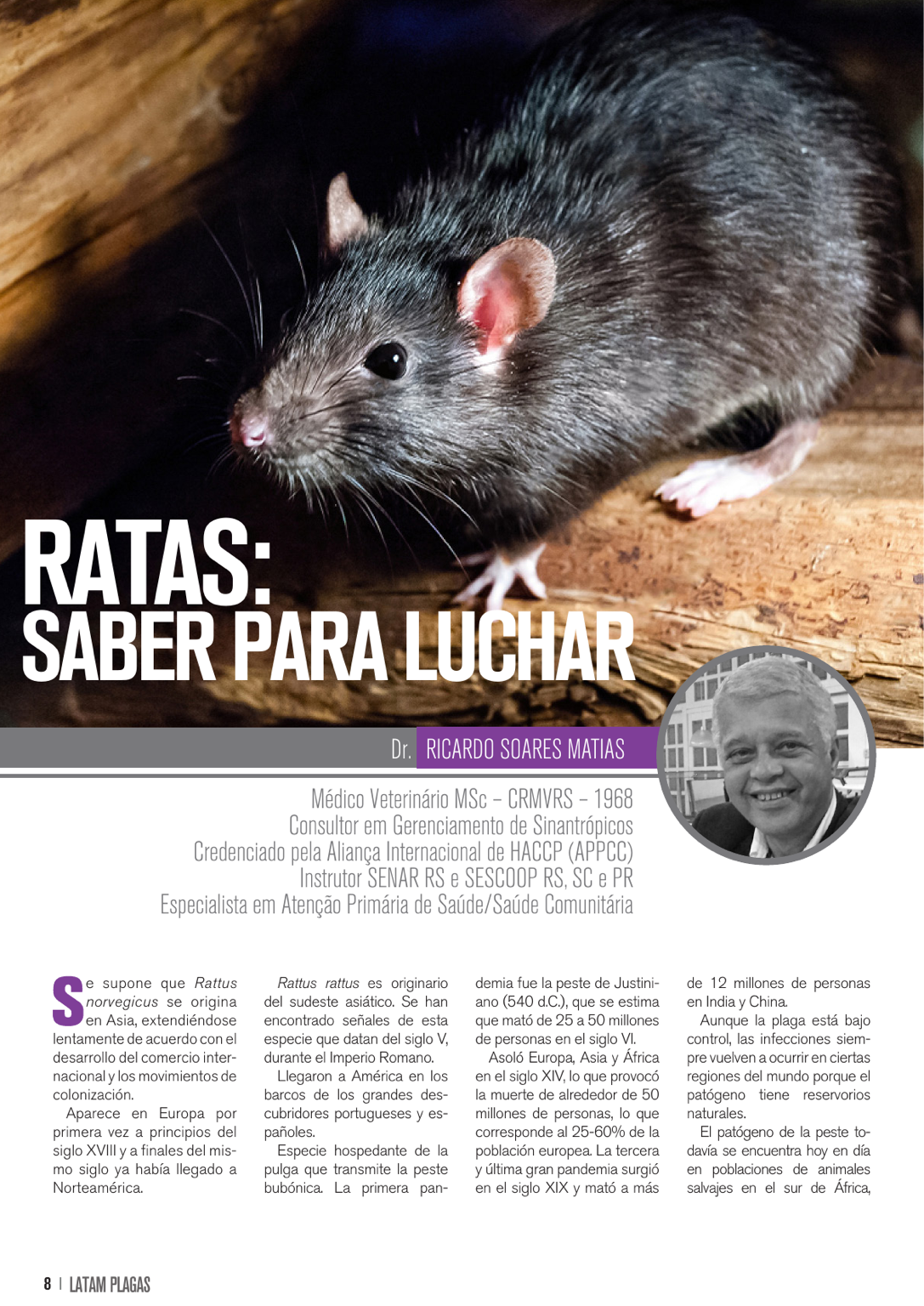
Rats: knowing them in order to fight them
Rattus norvegicus is thought to originate in Asia, spreading slowly in step with the development of international trade and waves of colonisation.
Technical summary
- Focus
- Rattus norvegicus is thought to originate in Asia, spreading slowly in step with the development of international trade and waves of colonisation.
- Approach
- The article structures the analysis around SIGHT, SMELL and TOUCH.
- Use
- Useful for professionals who need context, diagnosis and operational decisions in urban pests.
Index
Rattus norvegicus is thought to originate in Asia, spreading slowly in step with the development of international trade and waves of colonisation. It first appears in Europe at the start of the eighteenth century, and by the end of that same century it had already reached North America. Rattus rattus is native to south-east Asia. Signs of this species have been found dating from the fifth century, during the Roman Empire. They reached the Americas on the ships of the great Portuguese and Spanish explorers. It is the host species of the flea that transmits bubonic plague. The first pandemic was the Plague of Justinian (540 AD), estimated to have killed 25 to 50 million people in the sixth century. It devastated Europe, Asia and Africa in the fourteenth century, causing the deaths of around 50 million people, corresponding to 25–60% of the European population. The third and last great pandemic emerged in the nineteenth century and killed more
than 12 million people in India and China. Although plague is under control, infections still recur in certain regions of the world because the pathogen has natural reservoirs. The plague pathogen is still found today in wild animal populations in southern Africa, North and South America, Bolivia, Peru, Russia and Asia. The most recent epidemic was in August 2017 in Madagascar. Mus musculus is thought to originate in the steppes of Central Asia, from where it spread throughout the world. Known since the time of ancient Egypt, it was introduced to the Americas on the ships of the great Portuguese and Spanish explorers. Rats are rodents, but not all rodents are rats. It is therefore not correct to say that we fight rodents; we fight rats and mice. The main characteristic of the group is a pair of incisors above and below for gnawing, in permanent growth (10 to 12 cm a year). The name of the order derives from the Latin rodere, meaning to gnaw. Their structure has the front surface covered only with enamel and the back with dentine, which is softer. The incisors always take on a wedge shape, obtained by constant gnawing of hard objects or by the
enamel of one tooth grinding the dentine of the other through the movement of the quadrate bone, which allows jaw movement. Their tooth enamel rates 5.5 on the hardness scale and they can gnaw through walls at a ratio of 3:1 (3 sand to 1 cement). A gap, the diastema, exists between the incisors and the rest of the dentition to allow debris from gnawed objects to be expelled,
where the teeth are being used purely for gnawing.
SIGHT
Scientists at the Max Planck Institute used miniaturised high-speed cameras and discovered that rats move their eyes in opposite directions, both horizontally and vertically, while running. Each eye moves in a different direction depending on the change in the position of the animal's head. In humans both eyes see the same object; in rats each eye sees the same object separately and the images are not fused as they are in humans. Rats see only in green, blue and ultraviolet; they do not combine colours as humans do, who see in red, yellow, blue and green and their combinations. For rats and mice, objects of other colours appear grey. They also focus poorly and their vision is blurred and without outlines.
SMELL
Functional odours are produced in urine, faeces and the secretions of the apocrine and sebaceous glands (on the back, prepuce and eyes, for example). They respond naturally to the smells of predators, and laboratory studies reveal a great capacity to distinguish between closely related odours. Indian researchers have found that a single sniff is enough for a mouse to locate the source of a scent, with each nostril acting independently — meaning that each nostril perceives a different odour coming from opposite sides. Rats' ability to discriminate between odours coming from the right and from the left was tested. They chose the correct side with 80% accuracy. Rats are animals with large numbers of olfactory genes, 1,207 ORs (olfactory receptor genes), and mice have 1,130 ORs (which is what makes feeding easier for them), while humans have around 396 ORs.
TOUCH
Tactile hairs are found throughout the coat. The
nerve endings at the base of the body's guard hairs and of the whiskers are used as touch sensors, through which they carry out their movements in contact with a surface, allowing them to move in the dark. This is vital for a rapid escape from predation, where a rat will run along a narrow, previously memorised route. The whiskers are so sensitive that they can distinguish a smooth surface from a rough one, and do so better than our fingertips. They are also able to perceive light breezes and even sounds. Under water they can be used to detect currents or turbulence. Synaesthesia refers to the blending of the senses. These animals have highly developed senses across the board and blend them so as to recall memorised facts reliably, much as people do who work with mnemonic techniques. As they move, rats create an enormous web of associations: touch, hearing, smell, sight and even the taste of the areas they pass through. Rats' memory has several different representations (memory codes); that is, in the absence of perception through one sense, they have others with which to orient themselves.
HEARING
Rats can emit ultrasound to communicate without alerting predators, and it can also be useful for moving in the dark (echolocation), emitting ultrasound that bounces off obstacles and is received by the ears, as in bats. We hear in a range that runs, on average, from 20 Hz (hertz) to 20,000 Hz, with the best perception around 1,500 Hz. Rats hear from 250 Hz to 76,000 Hz, with the best perception around 8,000 Hz and 3,000 Hz. When frightened or angry, they warn their companions with squeals at 22,000 Hz. Electronic devices that emit ultrasound to drive rats away do not work because of the frequency they emit: some emit a frequency of 50 to 60 Hz, another 10,000 to 70,000 Hz and another 4,000 to 35,000 Hz. It must also be borne in mind that, as these are sound waves, any barriers present will be struck by the waves and create shadows.
FEEDING
Because they live in urban settings, with constant changes in the environment, they cannot count on a fixed place to find food and must make do with what they find, so it is very important for them to know what is edible and what will do them harm, safeguarding their health. First they are drawn by the smell, then they lick the food; when their taste buds start to work, if they like it, they will feed. Their memory for taste is extraordinary and, once they have tried a particular flavour, it will always be remembered. That is why they will always eat a given food that has proved agreeable. Rats are often wary of unfamiliar foods
and avoid them for a time. It also depends on hunger. Mice are more neophilic than rats. If a rat feels unwell within the next 16 hours or so, it will associate the illness with eating the new food and will not eat it again. The same applies to a rodenticide of which it did not ingest the lethal dose. One of the main reasons for the success of anticoagulants is the delay of several days between ingesting the bait and the appearance of symptoms; this prevents any association between cause and effect and the development of bait rejection. Foods eaten by a companion from the same colony are perceived by the others through their breath, through debris stuck to the snout or lips or even through the smell impregnated on the lips, and they will overcome neophobia more quickly, keeping that smell stored in memory; on encountering
food with the same smell they eat it without neophobia, which will lead to a recruitment of rats to the new food. Rats also learn from the misfortune of others, however: if a rat finds a new food and then finds a sick rat beside it, it will develop an aversion to that new food without eating it.
According to the WHO, 26 of the 999 causes of illness and death it classifies are caused by rats, whether through bites, contamination of food, faeces, urine or fleas that share the same habitat as humans. By gnawing grain destined for animal feed manufacture, they favour the entry of fungi, which can cause poisoning by mycotoxins such as aflatoxins and zearalenone.
We must also bear in mind that these animals are directly or indirectly responsible for transmitting a range of diseases to animals and/or humans, such as: leptospirosis, streptococcal meningitis, erysipelas, foot-and-mouth disease, salmonellosis, myocarditis, toxoplasmosis, hantavirus, tuberculosis, pasteurellosis, parabotulism, avian paratyphoid, chronic respiratory disease, enteritis, rat-bite fever, lymphocytic choriomeningitis, bubonic plague, murine typhus, spotted fever, trichinosis and others.
SETTING UP A
CONTROL PROGRAMME
STRUCTURING
To begin with, we must bear in mind that every unit has to be inspected, since leaving any out could compromise the whole process, as a significant rat population might be developing there. We must also bear in mind that control has to be carried out in both internal and external areas, since rats usually nest outside and come in looking for food. If, when we place baits, the weekly inspections show they are being consumed entirely, we must put out twice as much rodenticide. Baits should be placed where we find signs, numbered so they can be identified on worksheets and charts: droppings, gnaw marks, tracks, trails that may be of trampled grass, grease and dirt marks on wood and walls, worn wood, burrows and urine stains (being fluorescent, these can be identified with ultraviolet light — black light). Map the marks left by the rats and number the baits so as to know what is happening with each one. Since rats feel safer eating in more sheltered places, one way to improve control is to place the rodenticide bait inside pieces of 100 mm PVC pipe or in bait stations.
EXECUTION
This step comprises the application of a single-dose anticoagulant rodenticide.
Every rodenticide serves to kill rats and mice provided they ingest the corresponding lethal dose. Therein lies the main difference between rodenticides: their LD50. The lower the LD50, the more effective the rodenticide, since
the rat will need to ingest less product for the lethal effect to occur. We should remember that when we speak of a low LD50 for rats, it means being more toxic to rats and mice and not to non-target species. Inspections must be carried out weekly because rats take two to three days to begin feeling the effects of poisoning, and may take up to seven days to die. In places where there has been no consumption over three weeks, the product should not be discarded but used elsewhere where consumption is heavier. Baits that have been gnawed should stay in place until they are fully consumed, or be moved if consumption stops. Offer as many bait points as possible so that the rodents are more likely to find them.
ENVIRONMENTAL MANAGEMENT
Environmental management is the last activity to be carried out, so as to avoid rats realising that their surroundings have changed. It is done once control has been established, which we know when consumption that was high at the outset then drops and either stops altogether or becomes very small. Environmental management means cleaning, organising the surroundings and looking after the vegetation, as well as removing existing signs. It should never be carried out before the fight has been won. Often we do not achieve the success we want and must analyse the situation to see where we went wrong and reorganise our method. We can assess that failure in two ways:
(A) FIRST SITUATION: the baits are accepted but there is no control. — The bait was not left in place long enough. — There are more rats than baits. — Consumed baits take too long to be replaced (an interval of more than 7 days). — The baits are placed too close together, so that much of the colony has no access. — The area under control is too small, allowing rats from adjacent untreated colonies to invade the territory left vacant by the rats eliminated.
(B) SECOND SITUATION: the baits are not consumed. — The choice of bait was inappropriate or of poor quality. — Other food sources. — Bait in unsuitable places. — Spoiled baits (fermentation, damp, acidity). — The bait acquired an unpleasant smell or taste. — Poor bait quality detected by the rat.
A rodenticide formulation consists of a percentage of active ingredient and a carrier in which it is formulated. That carrier is
intended to appeal to rats' smell and taste; the more palatable it is and the more agreeable its smell, the greater the chances of consumption. It should be borne in mind that some substances may be unpleasant to them, so always wear gloves and never store baits where chemicals are kept. It is a myth, however, that the human smell on baits causes them to be refused, given that rats come into our homes and eat our food.
PELLET BAIT
These are for use in dry areas indoors or out. Finely ground cereals are mixed with a concentrated active ingredient and forced at high pressure through a die. Pellets are generally very palatable because they contain a high proportion of cereal and the active ingredient is evenly dispersed. In Brazil it is compulsory to include a bittering agent (denatonium benzoate) in rodenticides to prevent human ingestion. That safeguard has now been strengthened as a national company has begun impregnating its rodenticides with an organic warning dye. That is, any animal or person putting the rodenticide in their mouth will have a greenish tongue, identifying ingestion. Despite manufacturers' efforts to formulate baits that are as attractive as possible, we sometimes need to make them so ourselves. In Brazil it is prohibited to make contact dust palatable, but other formulations can be made appetising by mixing them with foods these animals enjoy, such as banana or papaya, brushing them with sardine oil or sugar syrup, or even with vanilla or sweet orange essence.
SUNFLOWER SEEDS
Sunflower seeds also contain large amounts of Fe, Ca, P, Na and K, B-group vitamins (thiamine, riboflavin and niacin), beta-carotene — a precursor of vitamin A — and vitamin E, the tocopherols. Sunflower seed is utterly irresistible to birds, which do not hesitate to enter houses to steal the prized protein-rich seeds. Sunflower seed can be considered highly energy-dense.
PARAFFIN BLOCK
This formulation is intended to overcome the
disadvantages of granular
baits, such as baiting in damp outdoor areas, in areas exposed to rain, or in high places infested by roof rats.
These products are likewise made from cracked or ground whole cereals, but contain a substantial proportion of paraffin, around 15 to 40%. The great problem is how much paraffin to add. More paraffin makes the block more weather-resistant but reduces its palatability. Too little lowers its resistance to the elements and increases palatability.
The resin block is made by a technique similar to the paraffin block, differing in that the paraffin — a petroleum derivative — is replaced by plant resin, a renewable product, and in that a water-based nanoemulsion is used to add the active ingredient to the formulation instead of organic solvents, with birdseed as an attractant that does not absorb water.
Starch is the main energy component of cereal grains (55 to 77%) and, in the extrusion process, its characteristics contribute to the expansion and cohesion of the final product, as well as increasing the bioavailability of some nutrients; and the low quantity of paraffin is unaffected by bad weather. The formulation is then cut and put through a drying process, in which the temperature falls and moisture is removed until it reaches around 12%.
This formulation makes up an adhesive rodenticide bait to be fixed at strategic points so that it does not come loose, thereby preventing its removal when the site is cleaned. Starch is the main energy component of cereals (55 to 77%) and represents an important source of energy.
These are formulations that use paraffin in just the right quantity to repel water, unlike paraffin formulations that use a greater volume of it. To give the bait consistency and shape, only the mechanical effect of hydraulic presses is used. Here there is no heating effect, which preserves in full the organoleptic properties of the attractants that form part of the bait.
CONTACT DUST
These are used on runways or at burrow entrances. Their use relies on rats' habit of licking themselves and one another when they reach their burrows. Rats passing over this dust get it on their feet. If it is applied at the exit of burrows, they will carry the dust to the places they pass through, which could contaminate food. This may represent a risk to people and pets and can cause poisoning. For that reason manufacturers are required by law to make clear on their packaging that this product cannot be used where pets are present. In Brazil, rodenticides can only be formulated at 0.05 g of active ingredient per kg of inert material. Contact dust formulations, however, are permitted at a concentration of 7.5 g/kg or 10 g/kg.
FRESH BAIT
This is an adhesive paste rodenticide bait, made up of a mixture of flaked cereal attractants (liquids with viscosity); besides these attractive components, a mixture of preservatives, humectants and the anticoagulant active ingredient goes into the formulation.