
Notes on SARS-CoV-2 and COVID-19, more than eighteen months after its detection
More than 19 months have passed since the alert about the presence of SARS-CoV-2, the virus that causes COVID-19, in Wuhan (China) in December 2019, and the road ahead remains complex and uncertain.
Technical summary
- Focus
- Desde la alerta de la presencia del virus SARS-CoV-2, causante de COVID-19, en diciembre del 2019 en Wuhan (China) hasta la fecha, han pasado más de 19 meses y todavía seguimos en un camino de horizonte complejo e incierto...
- Approach
- It brings together technical criteria linked to Edición 12, latam plagas and sars-cov-2.
- Use
- Useful for professionals who need context, diagnosis and operational decisions in public health and vectors.
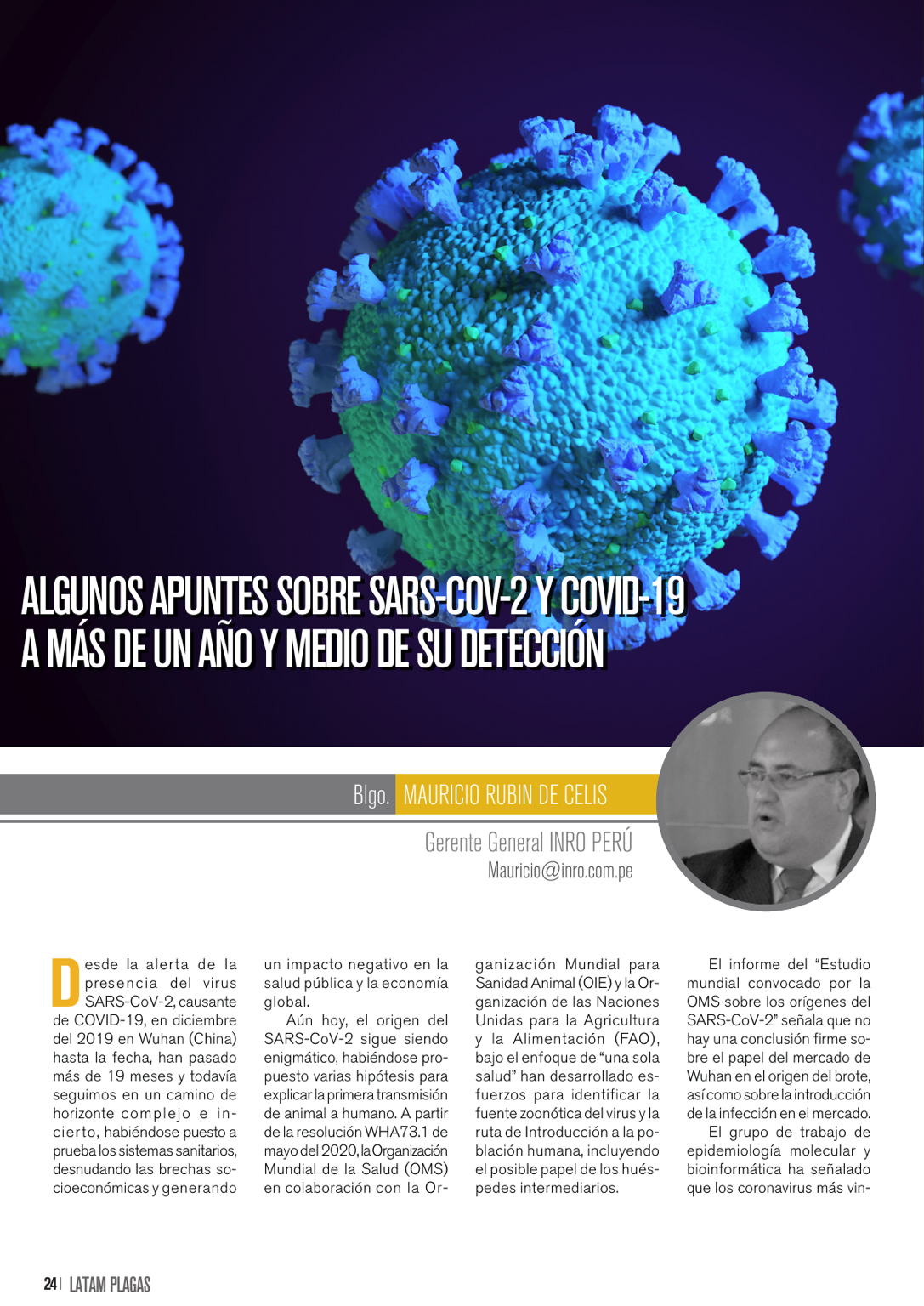
More than 19 months have passed since the alert about the presence of SARS-CoV-2, the virus that causes COVID-19, in Wuhan (China) in December 2019, and we are still on a road whose horizon is complex and uncertain. Health systems have been put to the test, socio-economic gaps have been laid bare, and the impact on public health and the global economy has been severe. Even today the origin of SARS-CoV-2 remains an enigma, and several hypotheses have been put forward to explain the first animal-to-human transmission. Following resolution WHA73.1 of May 2020, the World Health Organization (WHO), working with the World Organisation for Animal Health (OIE) and the Food and Agriculture Organization of the United Nations (FAO) under the “One Health” approach, has made efforts to identify the zoonotic source of the virus and the route by which it was introduced into the human population, including the possible role of intermediate hosts.
The report of the “WHO-convened global study of the origins of SARS-CoV-2” states that there is no firm conclusion about the role of the Wuhan market in the origin of the outbreak, nor about how the infection was introduced into the market. The molecular epidemiology and bioinformatics working group has noted that the coronaviruses most closely related to SARS-CoV-2 are found in bats and pangolins, suggesting that these mammals may be the reservoir of the virus. None of the viruses identified so far in these species, however, is similar enough to SARS-CoV-2 to be its direct progenitor. The mammals in question include four bat species: Rhinolophus acuminatus, Rhinolophus affinis, Rhinolophus malayanus, and the pangolin Manis javanica. The likelihood of different possible pathways for the introduction of the virus was assessed in general terms, including direct zoonotic transmission to humans, introduction through an intermediate host, introduction linked to the food chain and introduction through a laboratory incident. Direct zoonotic spread is considered a possible and likely pathway; introduction through an intermediate host a very likely pathway; introduction through food-chain products a possible pathway; and introduction through a laboratory incident an extremely unlikely one. As for changes in the virus revealed by genomic surveillance, it is important to note that viral replication should not be seen only as a mechanism for increasing the quantity of virus: because it involves synthesising new copies of the viral genome more or less imperfectly, it also allows the virus to adapt. The new copies carry small changes called mutations. A virus that has undergone one or more mutations is a variant of the original virus, and the more virus circulates, the more scope there is for modification. Most changes may have no great impact on the properties of the virus. Some changes, however, can favour spread, increase the severity of disease and reduce the effectiveness of vaccines, therapeutic drugs and diagnostic tools, among others. Variants of that kind are considered “variants of concern”. Four variants with those characteristics are currently recognised: ALPHA (United Kingdom, December 2020), BETA (South Africa, December 2020), GAMMA (Brazil, January 2021) and DELTA (India, May 2021). On prevention, the emphasis remains on the need to vaccinate the whole population. That has once again revealed the inequality between countries in vaccine distribution, to the point that WHO has stated that “vaccine inequity is the biggest obstacle to ending the pandemic and recovering from COVID-19”. Political will is needed to remove the barriers that prevent vaccine manufacturing from being scaled up and to secure the financial support for vaccines to be distributed equitably; only then will there be a genuine global economic recovery. As for the types of vaccine available, some have been developed with inactivated or attenuated viruses that do not cause disease but do produce an immune response. Protein-based vaccines use harmless protein fragments or protein structures that mimic the virus causing COVID-19, generating an immune response. Viral vector vaccines use a genetically modified virus that does not cause disease but gives rise to coronavirus proteins that induce an immune response. Lastly, RNA and DNA vaccines are genetically engineered to produce a protein that by itself triggers an immune response. In every case the duration of immunity and the need to extend the schedule with booster doses are under discussion. Alongside vaccination, the recommendations on wearing masks, physical distancing, frequent handwashing with soap and avoiding crowded, poorly ventilated places all remain in force. As for transmission via fomites, although its real importance is debated, bodies such as the United States Centers for Disease Control and Prevention (CDC) continue to recommend cleaning and disinfecting high-contact surfaces. The professional use of disinfectants of known effectiveness for inactivating SARS-CoV-2 plays a fundamental part. A study entitled “In vitro inactivation of SARS-CoV-2 by commonly used disinfection products and methods”, by researchers at China's Ministry of Health, reports on chlorine-based disinfectants that the one containing 250 mg/L of available chlorine took 20 minutes to inactivate SARS-CoV-2 effectively; likewise the disinfectant containing 500 mg/L of available chlorine took 5 minutes to inactivate it effectively, and the disinfectant containing 1,000 mg/L of available chlorine needed less than 0.5 minutes. As for quaternary ammonium salts, a 170 mg/L dilution of DNB disinfectant can inactivate SARS-CoV-2 effectively after 5 minutes of contact time. At a DNB concentration of 212 mg/L the virus was inactivated with similar efficacy to the 283 mg/L dilution, and higher DNB concentrations required only 0.5 minutes to inactivate the virus efficiently. On the use of alcohols, a 20% ethanol solution could not inactivate the virus, whereas a 30% ethanol solution inactivated it efficiently in 1 minute. A disinfectant solution of 40% ethanol or more required only 0.5 minutes to inactivate SARS-CoV-2 efficiently. Finally, on the use of drug therapy, after
several months of delay, Solidarity is being restarted — a global study led by the World Health Organization that will test three new drugs in hospitalised COVID-19 patients. The drugs to be trialled are the cancer drug imatinib, an antibody called infliximab used to treat autoimmune diseases, and artesunate, an antimalarial. In June 2020 a trial in the United Kingdom found that dexamethasone, a low-cost steroid, reduced deaths by up to a third. In February 2021 Recovery researchers announced that tocilizumab, a monoclonal antibody
that blocks the interleukin-6 receptor, reduced mortality a little further. Both drugs work by damping down the excessive immune response in critically ill patients, which is why the new drugs to be trialled also target the immune system rather than the virus itself. The pandemic has been generating both synergies and tensions between science and politics; what is urgently needed, however, is for those efforts to converge on concrete action for the benefit of the population, above all the most vulnerable, since the health impact — including mental health — and the economic crisis keep growing.